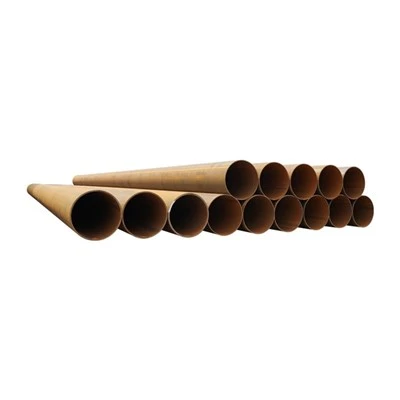
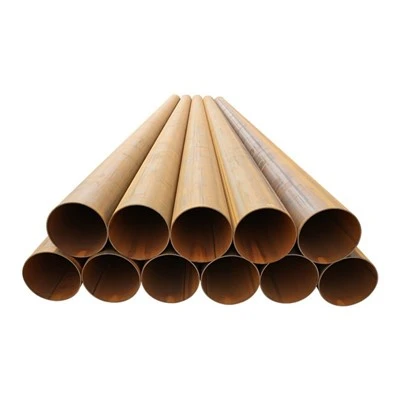
LSAW steel pipe is widely recognized for its role in oil and gas transmission, but its application is not limited to pipeline transportation. Because of its high structural strength, large diameter capability, reliable longitudinal weld, and flexible wall thickness range, LSAW steel pipe is also used in structural engineering, marine structures, bridge construction, foundation systems, industrial facilities, and large architectural projects.
Unlike conventional structural sections, large-diameter LSAW steel pipe can provide a closed circular cross-section with good resistance to compression, bending, torsion, and buckling. The manufacturing process begins with steel plate forming and longitudinal submerged arc welding, allowing manufacturers to produce customized diameters and wall thicknesses according to structural calculations and project specifications.
For structural applications, pipe selection involves more than simply choosing a diameter. Engineers need to consider axial load, bending moment, buckling behavior, connection design, environmental exposure, fabrication requirements, and applicable structural standards. Depending on the application, LSAW steel pipe can be manufactured using suitable carbon structural steel or low-alloy steel grades and supplied with surface protection when required.
| Structural Application | Main Function | Important Considerations |
|---|---|---|
| Bridge Structures | Columns, piers, supports | Compression, bending, fatigue |
| Building Structures | Columns and load-bearing members | Axial load, buckling, connections |
| Marine Structures | Piles, supports, offshore components | Corrosion, wave and impact loads |
| Foundation Engineering | Steel pipe piles | Axial and lateral bearing capacity |
| Industrial Structures | Supports and frames | Heavy loads, fabrication |
| Stadiums and Large Buildings | Long-span structural members | Strength, stability, appearance |
| Port Infrastructure | Piles and structural supports | Seawater corrosion, impact |
Why Is LSAW Steel Pipe Suitable for Structural Engineering?
Structural engineering requires materials capable of carrying loads while maintaining dimensional stability throughout the design service life. LSAW steel pipe provides several characteristics that make it suitable for large structural members.
How Does the Circular Cross Section Improve Structural Performance?
A circular steel pipe distributes material around its neutral axis, giving it favorable resistance to loads from different directions. This is particularly useful for columns, piles, bridge supports, and structures exposed to multidirectional loading.
The closed cross-section can provide good resistance to torsion and bending while reducing the possibility of localized weak directions compared with some open structural sections.
How Does Diameter Affect Structural Capacity?
Increasing the outside diameter can significantly influence the second moment of area and radius of gyration of the structural member. However, structural capacity also depends on wall thickness, steel grade, member length, connection design, and boundary conditions.
Therefore, diameter and wall thickness should be selected through engineering calculations rather than by using a general-purpose pipe size.
How Is LSAW Steel Pipe Used for Building Columns?
Large buildings, exhibition halls, stadiums, industrial workshops, and other large structures can use steel pipe as vertical load-bearing columns.
Why Are Large Diameter Steel Pipe Columns Used?
Large-diameter LSAW steel pipe can provide high axial load capacity while maintaining a relatively compact structural profile. The circular geometry can also provide favorable buckling characteristics when properly designed.
For buildings with large open spaces, steel pipe columns can support substantial loads without creating excessively large structural footprints.
How Are Connections Designed?
Structural pipe columns may connect to beams, trusses, base plates, or other structural members through welded or bolted connection systems.
The connection design must account for load transfer, local stresses, weld capacity, fabrication tolerances, and installation requirements. Consequently, the pipe specification should be coordinated with the structural connection design from the beginning of the project.
Where Is LSAW Steel Pipe Used in Bridge Structures?
Bridges require structural members capable of resisting combinations of compression, tension, bending, vibration, and dynamic loading.
How Can Steel Pipe Support Bridge Construction?
LSAW steel pipe can be used for bridge piers, columns, tubular trusses, arch components, support structures, and other large structural members.
Its closed circular section provides good resistance to bending and torsion, while large diameters allow engineers to design substantial structural members with controlled geometry.
Why Is Fatigue Performance Important?
Bridge structures are subjected to repeated vehicle and environmental loads throughout their service life. Welded connections and structural details therefore require careful design to minimize stress concentrations and fatigue risks.
Manufacturing quality, weld inspection, dimensional accuracy, and material properties are important considerations when LSAW steel pipe is used in fatigue-sensitive structural applications.
How Is LSAW Steel Pipe Used in Foundation Engineering?
Foundation systems are another important structural application for large-diameter steel pipe.
Why Are LSAW Steel Pipe Piles Used?
Steel pipe piles transfer structural loads from buildings, bridges, ports, and other facilities into deeper and stronger soil layers. Large-diameter pipe piles can provide substantial axial and lateral capacity.
LSAW manufacturing is suitable for large pipe pile specifications because steel plate can be formed into different diameters and wall thicknesses according to project requirements.
What Factors Affect Pipe Pile Selection?
Pile diameter, wall thickness, steel grade, pile length, soil conditions, driving method, axial capacity, lateral loads, and corrosion allowance all influence the final specification.
The pipe must also be designed to withstand stresses generated during transportation, lifting, handling, and pile driving.


Can LSAW Steel Pipe Be Used in Marine Structures?
Marine engineering creates particularly demanding structural conditions because components can be exposed to seawater, wave loading, wind, impact, and cyclic stresses.
What Marine Structures Use Large Diameter Steel Pipe?
LSAW steel pipe can be used for marine piles, port structures, dolphins, supports, offshore structures, and other tubular structural components.
Large-diameter members are especially useful where substantial vertical or lateral loads need to be transferred through a relatively compact structural section.
How Is Corrosion Controlled in Marine Environments?
Marine steel structures require careful corrosion management. Depending on the project, external protective coatings, cathodic protection, corrosion allowance, or combinations of these methods can be applied.
Coating systems such as FBE, 3PE, or other project-specified protective systems may be considered depending on the exposure environment and design requirements.
How Does LSAW Steel Pipe Support Large Architectural Structures?
Modern architecture increasingly incorporates large steel members into stadiums, airports, exhibition centers, shopping complexes, and transportation hubs.
Why Are Tubular Members Attractive for Large Structures?
Circular steel members provide a clean geometric appearance and can accommodate loads from multiple directions. They are particularly useful for large-span roofs, space frames, entrance structures, and architectural support systems.
How Does Manufacturing Flexibility Help Designers?
LSAW production allows manufacturers to adjust pipe diameter and wall thickness according to engineering requirements. This flexibility can be valuable when a project requires non-standard or relatively large structural members.
At the same time, dimensional tolerances must be controlled carefully because structural members need to align accurately during site assembly.
What Quality Requirements Should Be Considered for Structural LSAW Steel Pipe?
Structural applications require systematic quality control from raw material selection through final inspection.
Which Properties Are Important?
Engineers may evaluate yield strength, tensile strength, elongation, impact toughness, weld quality, dimensional tolerances, straightness, and surface condition.
Depending on the structural standard and project specification, non-destructive testing can be used to examine the longitudinal weld and identify potential internal or surface imperfections.
Why Is Material Traceability Important?
Structural projects require reliable documentation because the pipe becomes part of a permanent load-bearing system. Heat numbers, material certificates, inspection reports, welding records, and dimensional data can provide traceability throughout fabrication and construction.
Project Reference: LSAW Steel Pipe for a Hong Kong Structural Project
A previous Hong Kong Bridge Street Shopping Centre Project provides an example of large-diameter welded steel pipe being used in structural engineering. The project required approximately 5,700 tons of LSAW steel pipe manufactured to EN 10219 S275JOH, with a specification of 813 mm × 20 mm × 11.9 m.
The substantial pipe diameter and 20 mm wall thickness were suitable for demanding structural applications, where dimensional accuracy, material consistency, weld quality, and fabrication performance were important. The project demonstrates how large-diameter LSAW steel pipe can be incorporated into major commercial and structural infrastructure projects.
Read More:
How Is LSAW Steel Pipe Manufactured And Where Is It Used in Modern Engineering?
Where Is LSAW Steel Pipe Used in Modern Pipeline And Infrastructure Projects?