


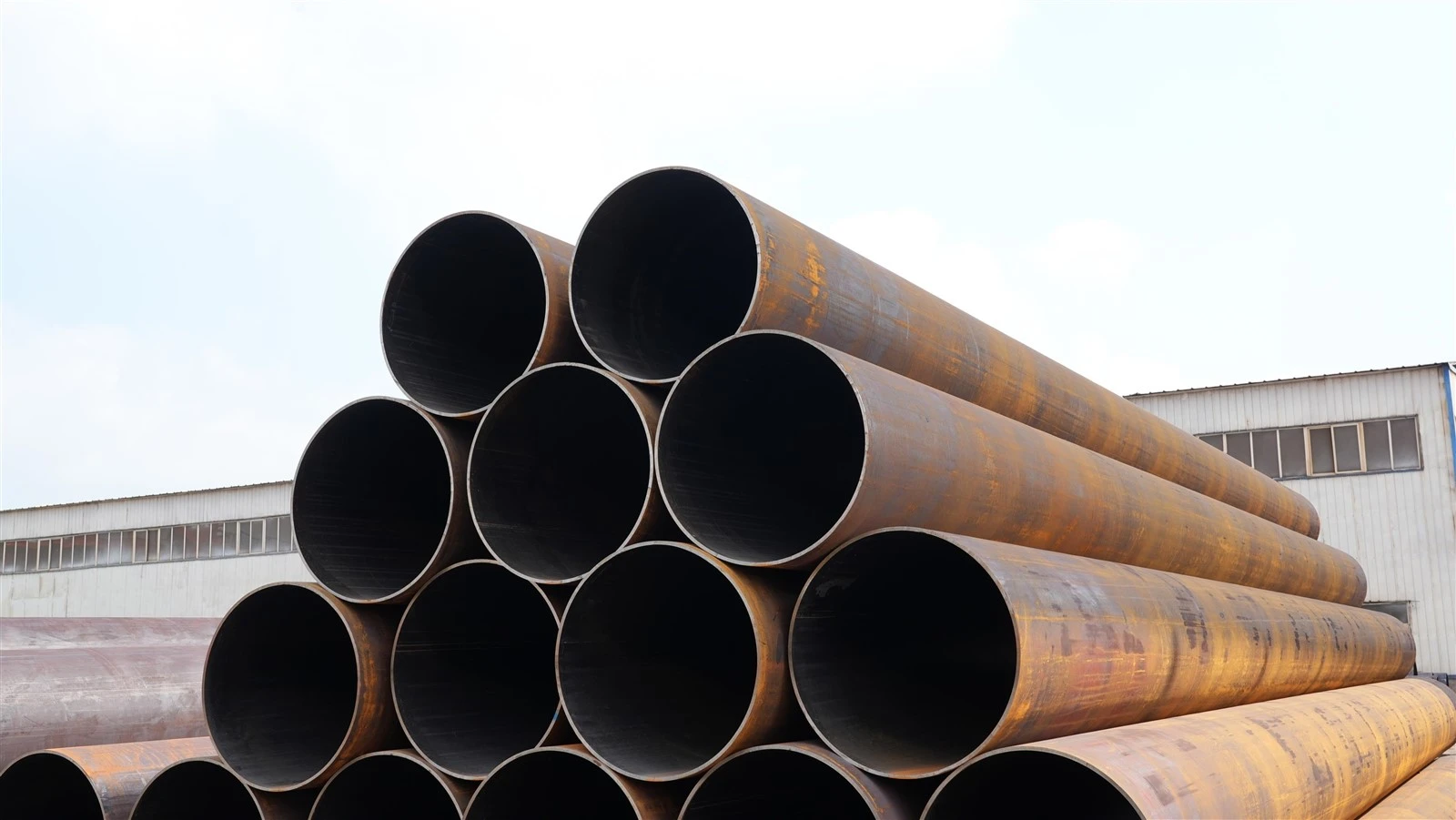
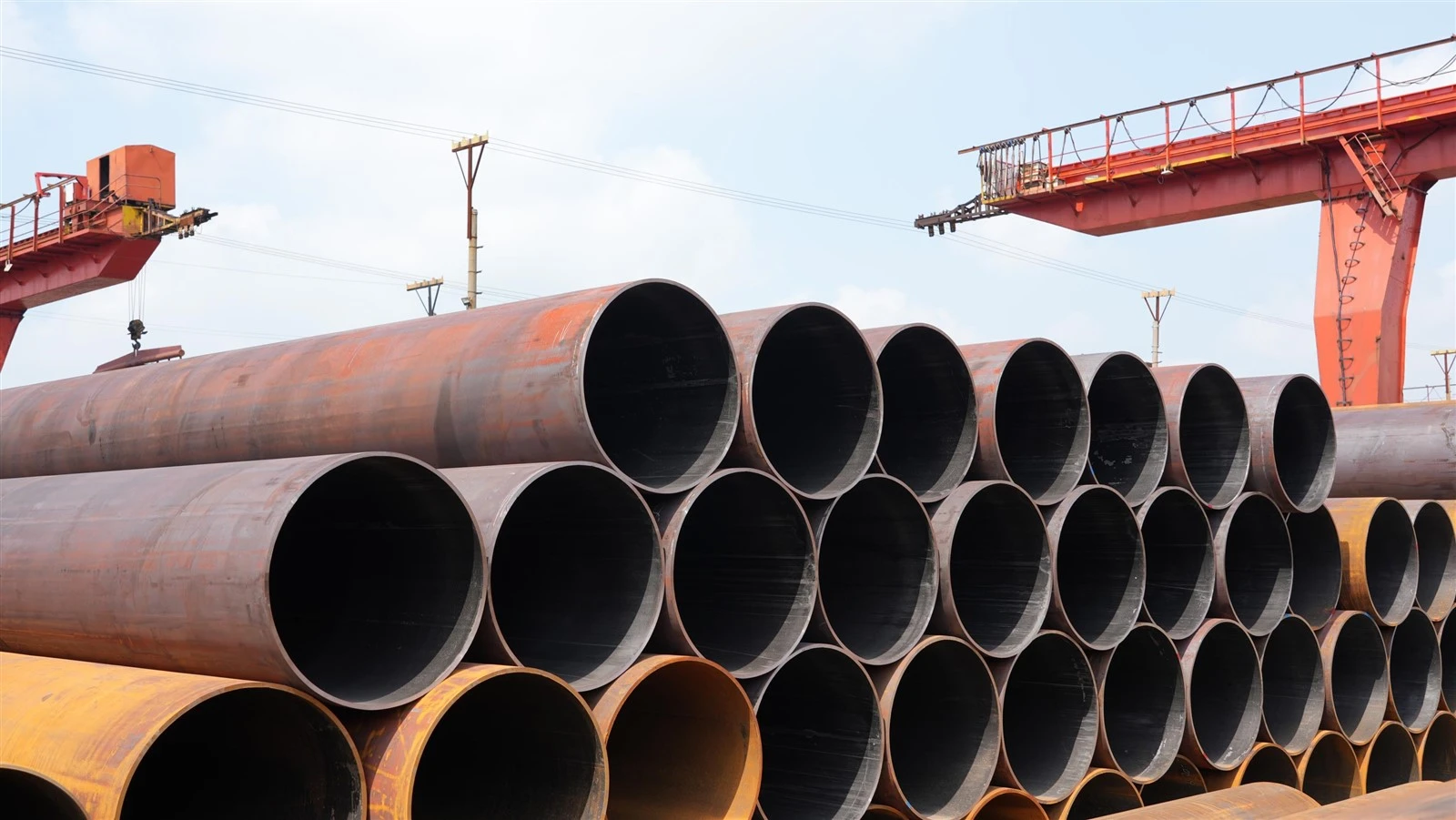
SSAW steel pipe, also known as spiral submerged arc welded pipe or spiral welded steel pipe, is manufactured by forming a continuous steel strip into a cylindrical shape and welding the helical seam using the submerged arc welding process. Compared with straight seam welded pipe, SSAW production allows manufacturers to produce large-diameter steel pipes from relatively wide steel coils while maintaining controlled production efficiency and weld quality.
The manufacturing process involves several closely controlled stages, including raw material inspection, coil preparation, strip forming, spiral welding, cutting, nondestructive testing, hydrostatic testing, and pipe-end processing. For infrastructure, water transmission, piling, structural, and pipeline applications, understanding how SSAW steel pipe is made helps buyers evaluate product quality and manufacturing capability.
What Is SSAW Steel Pipe and How Does the Manufacturing Process Work?
SSAW stands for Spiral Submerged Arc Welding. During production, a steel strip is continuously formed into a cylindrical shape at a controlled angle. The edges of the strip are then joined along a spiral seam by submerged arc welding.
How Does Spiral Forming Create a Large-Diameter Pipe?
Unlike straight seam processes, the spiral forming method uses the width and forming angle of the steel strip to determine the finished pipe diameter. This makes SSAW manufacturing particularly suitable for large-diameter steel pipe production.
Continuous Forming and Seam Welding
The steel strip enters the forming unit continuously. Forming rolls gradually bend the strip until it becomes cylindrical. At the same time, the forming parameters, strip alignment, welding angle, and seam position are monitored to maintain dimensional stability.
The helical seam is welded continuously as the strip moves through the production line. Depending on the production equipment and applicable specification, internal and external submerged arc welding may be used to provide a sound welded joint.
What Materials Are Used in SSAW Pipe Production?
The main raw material is steel strip or coil. Its chemical composition, mechanical properties, dimensions, surface condition, and traceability must be verified before production. Welding wire and flux are also important because their characteristics directly affect the quality and mechanical performance of the welded seam.
| Manufacturing Stage | Main Control Item | Typical Quality Focus |
|---|---|---|
| Raw material inspection | Steel coil, welding wire, flux | Chemical and mechanical properties |
| Coil preparation | Width, thickness, surface | Dimensional accuracy and surface condition |
| Strip forming | Forming angle and alignment | Diameter and roundness |
| Submerged arc welding | Current, voltage, speed, flux | Weld penetration and stability |
| Cutting | Pipe length | Length tolerance and squareness |
| NDT | Weld seam | Internal and surface defects |
| Hydrostatic testing | Pressure and holding time | Leak resistance |
| End finishing | Bevel and end face | Connection and installation requirements |
What Are the Main Steps in SSAW Steel Pipe Manufacturing?
The SSAW manufacturing process is a continuous operation, but each stage has a specific role in controlling the final pipe's dimensions, weld quality, and mechanical performance.
Step 1: Steel Coil Inspection and Preparation
Before entering the production line, steel coils are inspected according to the purchase specification and applicable standard. Chemical composition, tensile properties, yield strength, thickness, width, and surface quality are checked as required.
The coil is then prepared for continuous forming. Surface defects that could affect forming or welding need to be identified and controlled before the material enters the main production process.
Coil Uncoiling, Leveling and Edge Preparation
The steel strip is uncoiled and leveled to obtain stable flatness. The strip edges are also prepared to ensure consistent contact during forming and welding. Proper edge condition is particularly important because the two edges become the weld seam of the finished SSAW pipe.
Step 2: Strip Forming and Diameter Control
The prepared strip passes through a series of forming rolls. The rolls gradually bend the flat strip into a cylindrical shape while maintaining the specified forming angle.
Controlling Pipe Diameter and Weld Alignment
During this stage, manufacturers continuously monitor pipe diameter, ovality, strip position, and seam alignment. Excessive deviation in forming conditions can affect both dimensional accuracy and welding stability.
The welding gap must also be controlled within the required range. A stable gap helps maintain consistent penetration and reduces the risk of weld defects.
Step 3: Submerged Arc Welding of the Spiral Seam
Once the strip has been formed, the spiral seam is welded using submerged arc welding. In this process, welding wire melts under a layer of granular flux. The flux shields the welding area from atmospheric contamination and contributes to stable arc conditions.
Internal and External Spiral Seam Welding
Depending on the equipment configuration and production requirements, the spiral seam can be welded from both the inside and outside of the pipe. Welding parameters such as current, voltage, travel speed, wire feed, and flux condition must be controlled throughout production.
Why Is Welding Parameter Control Important?
Incorrect welding parameters can lead to incomplete penetration, lack of fusion, excessive reinforcement, undercutting, or other weld imperfections. Therefore, stable welding conditions are essential for producing SSAW steel pipe that meets the required mechanical and inspection criteria.
Step 4: Online Weld Inspection
After welding, the spiral weld is inspected using appropriate nondestructive testing methods. Ultrasonic testing is commonly used to identify internal discontinuities in the weld area, while other inspection methods may be applied according to the applicable standard, customer specification, and project requirements.
If a signal indicates a potential defect, the relevant section can be identified for further evaluation. Corrective action and process adjustment are then carried out when necessary.
Step 5: Cutting the Pipe to Specified Lengths
Once a continuously formed and welded pipe reaches the required length, it is cut into individual pipe sections. Cutting equipment must maintain the specified length tolerance while minimizing deformation of the pipe end.
For project orders, pipe length can be determined according to the applicable standard and purchaser requirements. Long-length production can also be arranged where the manufacturing and transportation conditions permit.
How Is SSAW Steel Pipe Tested After Welding?
Manufacturing quality control does not end after the spiral seam has been welded. Finished pipes normally undergo dimensional inspection, weld inspection, mechanical testing, and other examinations required by the applicable standard or purchase specification.
What Nondestructive Tests Are Used for SSAW Pipe?
Ultrasonic testing is an important method for examining the spiral weld. Depending on the required specification, radiographic testing, magnetic particle testing, visual inspection, or other NDT methods may also be used.
Weld Seam Inspection and Defect Evaluation
Typical inspection focuses on weld continuity, penetration, fusion, surface condition, and dimensional characteristics. Butt welds between steel coils, where applicable, also require appropriate inspection because they become part of the continuous production process.
Is Hydrostatic Testing Required for SSAW Steel Pipe?
For applications where pressure resistance is required, hydrostatic testing can be performed according to the applicable standard or purchaser specification. During the test, the pipe is filled with water and subjected to a specified pressure for a defined period.
Hydrostatic testing helps verify the pressure integrity of the finished pipe and identify leakage that may not be detected through visual examination alone. Test pressure, holding time, and acceptance criteria depend on the relevant standard and project requirements.
How Are SSAW Pipe Ends Finished Before Delivery?
After inspection and testing, pipe ends can be processed according to the connection requirements of the project. End squareness, bevel angle, root face, and dimensional tolerances are controlled during finishing.
For welded pipeline applications, bevelled ends may be required for field girth welding. For piling, structural, water transmission, or other applications, different end configurations may be specified.
Marking is also applied according to the order requirements. Important information may include pipe size, wall thickness, steel grade, standard, heat or batch number, and manufacturer identification, supporting traceability throughout transportation and installation.
What Quality Factors Should Buyers Check When Purchasing SSAW Steel Pipe?
For buyers, evaluating SSAW steel pipe should involve more than checking outside diameter and wall thickness. The manufacturing standard, steel grade, welding process, inspection requirements, and documentation should all correspond to the intended application.
A qualified manufacturer should be able to provide traceability from the incoming steel coil through forming, welding, testing, and final inspection. This is especially important for large-diameter pipes used in water transmission, infrastructure, structural projects, piling, and other demanding applications.
Huayang Steel Pipe provides welded steel pipe solutions for different project requirements, with manufacturing capabilities covering HFW/ERW, LSAW, and related pipe processing. For project-specific requirements, dimensions, steel grades, standards, testing, coating, and pipe-end processing can be coordinated according to the technical specification.
Why Is SSAW Steel Pipe Widely Used in Large-Diameter Applications?
The spiral welding process provides flexibility in large-diameter pipe manufacturing and can be adapted to different steel grades, dimensions, and project requirements. Its continuous forming process is also suitable for producing substantial quantities of large-diameter welded pipe.
SSAW steel pipe can be used in applications such as water transmission, piling, structural engineering, industrial infrastructure, and certain pipeline systems. The appropriate pipe type should always be selected according to design pressure, service conditions, required dimensions, material grade, applicable standard, and project specifications.
Conclusion
The SSAW steel pipe manufacturing process combines continuous steel strip forming with spiral submerged arc welding and multiple stages of inspection and testing. From steel coil preparation and edge control to forming, internal and external welding, NDT, hydrostatic testing, cutting, and end finishing, every stage contributes to the final quality of the spiral welded pipe.
For buyers, understanding this production process makes it easier to evaluate manufacturing capability and select SSAW steel pipe that matches the technical requirements of a specific project. With controlled production and complete quality inspection, spiral welded steel pipe can provide a practical solution for many large-diameter infrastructure and engineering applications.
Read More:
What Are The Top 5 Uses Of ERW Pipes in Modern Infrastructure Projects?
What Does A Steel Pipe Manufacturer Really Do Beyond Production?


