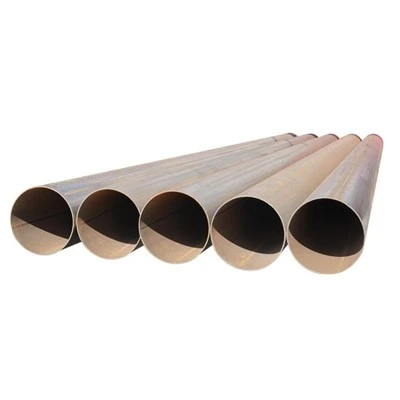
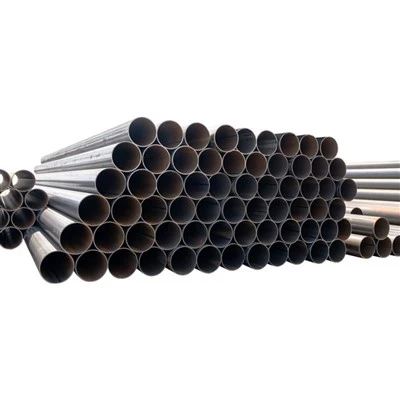
In the diverse landscape of steel pipe manufacturing, Electric Resistance Welded (ERW) steel pipes stand out for their efficiency, versatility, and cost-effectiveness, particularly in mid-range pipeline applications. Unlike LSAW pipes which are formed from plates and then welded, ERW pipes are produced from steel coils, continuously formed into a cylindrical shape, and then welded longitudinally using high-frequency induction heating. This process, often referred to as High-Frequency Welding (HFW), offers distinct advantages that make ERW pipes an ideal choice for various projects, from water transmission and distribution to oil and gas gathering lines, and structural applications. So, what defines the efficiency of ERW steel pipes, and why is High-Frequency Welding ideal for mid-range pipeline applications? Hebei Huayang Steel Pipe Co., Ltd., a prominent manufacturer of ERW steel pipes, explores the technical and economic benefits of this advanced manufacturing method.
Understanding the ERW/HFW Manufacturing Process
The ERW/HFW process is a continuous, automated method that transforms flat steel strips (coils) into finished pipes. The key steps include:
1.Uncoiling and Leveling: Steel coils are uncoiled and flattened to ensure uniform material properties.
2.Edge Trimming: The edges of the steel strip are precisely trimmed to ensure clean, parallel surfaces for welding.
3.Forming: The flat strip is progressively formed into an open-seam cylindrical shape through a series of rollers.
4.High-Frequency Welding (HFW): This is the core of the process. High-frequency alternating current is passed through the edges of the open seam. The electrical resistance generates intense heat at the edges, bringing them to a plastic state. Pressure rollers then forge the heated edges together, creating a strong, solid-state weld without the addition of filler metal.
5.Scarfing: Excess metal (flash) formed on the inner and outer surfaces of the weld seam is removed to ensure a smooth surface.
6.Heat Treatment (Optional but Recommended): The weld seam is often subjected to an inline heat treatment (e.g., normalizing) to refine the grain structure and improve the mechanical properties of the weld zone, making it comparable to the parent material.
7.Sizing and Straightening: The pipe is then sized to its final diameter and straightened.
8.Cutting and End Finishing: Pipes are cut to specified lengths, and ends are beveled as required.
9.Non-Destructive Testing (NDT) and Inspection: Comprehensive NDT (e.g., ultrasonic testing of the weld seam) and dimensional inspections are performed to ensure quality and integrity.


The Efficiency Advantage of ERW/HFW Pipes
The HFW process imparts several efficiencies and benefits that make ERW pipes highly competitive for mid-range applications:
1. High Production Speed and Cost-Effectiveness
•Continuous Process: Unlike batch processes, HFW is continuous, allowing for very high production rates. This translates to faster delivery times and lower manufacturing costs per unit length.
•No Filler Metal: The solid-state welding process eliminates the need for filler metals, reducing material costs and simplifying the welding operation.
•Energy Efficiency: High-frequency induction heating is a highly efficient method of concentrating heat precisely where it's needed, minimizing energy waste.
2. Superior Weld Quality and Integrity
•Solid-State Weld: The HFW process creates a forge weld, where the metal edges are pressed together in a plastic state, resulting in a strong, homogeneous bond that is often stronger than the parent material.
•Narrow Heat-Affected Zone (HAZ): The localized and rapid heating minimizes the heat-affected zone, preserving the mechanical properties of the surrounding pipe material.
•Online Heat Treatment: When followed by inline heat treatment, the weld seam's microstructure is refined, eliminating any potential hardness variations and ensuring uniform mechanical properties across the pipe body and weld.
•100% Weld Inspection: Modern ERW lines are equipped with advanced online NDT systems (e.g., phased array ultrasonic testing) that continuously inspect the entire weld seam, ensuring defect-free production.
3. Excellent Dimensional Accuracy and Surface Finish
•Precise Forming: The continuous forming process ensures excellent control over the pipe's diameter, wall thickness, and straightness.
•Smooth Surfaces: The scarfing process removes internal and external flash, resulting in smooth weld seams that are ideal for coating applications and reduce flow resistance.
4. Versatility in Applications
ERW pipes are suitable for a wide range of mid-range applications, typically covering diameters from 0.5 inches to 24 inches (12.7 mm to 610 mm) and wall thicknesses up to 0.625 inches (15.9 mm). Their applications include:
•Oil and Gas Gathering Lines: Transporting crude oil and natural gas from wellheads to main transmission lines.
•Water Transmission and Distribution: Municipal water supply, irrigation systems.
•Structural Applications: Piling, construction, scaffolding, and mechanical tubing.
•Process Piping: Industrial plants, chemical processing.
Hebei Huayang: Delivering Efficient and Reliable ERW Steel Pipes
At Hebei Huayang Steel Pipe Co., Ltd., our state-of-the-art ERW/HFW production lines are designed for maximum efficiency and uncompromising quality. We utilize advanced high-frequency welding technology, coupled with inline heat treatment and rigorous online and offline non-destructive testing, to produce ERW steel pipes that meet and exceed international standards such as API 5L, ASTM, and EN.
Our commitment to precision engineering and stringent quality control ensures that every ERW pipe leaving our factory offers superior weld integrity, excellent dimensional accuracy, and reliable performance. By choosing Huayang's ERW steel pipes, you are investing in an efficient, cost-effective, and durable solution for your mid-range pipeline and structural projects.
Key Efficiencies and Benefits of ERW/HFW Steel Pipes
|
Feature |
Description |
Benefit for Mid-Range Pipeline Applications |
|
High Production Speed |
Continuous, automated manufacturing process. |
Faster delivery, lower manufacturing costs, meets project timelines. |
|
Superior Weld Quality |
Solid-state forge weld with narrow HAZ. |
Strong, homogeneous weld, comparable to parent material, high integrity. |
|
Online Heat Treatment |
Refines weld seam microstructure. |
Ensures uniform mechanical properties, eliminates hardness variations. |
|
Excellent Dimensional Accuracy |
Precise forming and sizing. |
Facilitates easy installation, good fit-up, smooth flow characteristics. |
|
Cost-Effectiveness |
No filler metal, efficient energy use. |
Economical solution for various projects without compromising quality. |
|
Versatility |
Wide range of diameters and wall thicknesses. |
Suitable for diverse applications: oil/gas gathering, water, structural. |
In conclusion, the efficiency of ERW steel pipes, driven by the advanced High-Frequency Welding (HFW) process, makes them an ideal and highly competitive choice for a broad spectrum of mid-range pipeline and structural applications. Their combination of high production speed, superior weld quality, excellent dimensional accuracy, and cost-effectiveness provides significant advantages for project developers and operators. Hebei Huayang Steel Pipe Co., Ltd. is proud to offer ERW steel pipes that embody these efficiencies, delivering reliable and high-performance solutions to power industries worldwide.