In modern engineering construction, steel pipes are not only basic materials but also directly related to the safety, stability, and service life of projects. Among various types of welded steel pipes, LSAW (Longitudinal Submerged Arc Welded) steel pipes are widely used in oil and gas transmission, urban pipe networks, and large-scale infrastructure projects due to their stable structural performance and reliable welding quality. This article will systematically explain LSAW steel pipes from aspects such as manufacturing methods, performance characteristics, and application scenarios.
I. What is LSAW Steel Pipe?
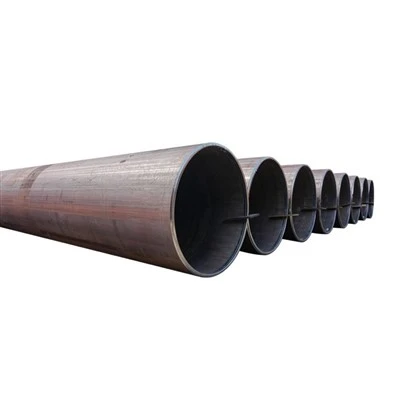
LSAW steel pipe generally refers to longitudinal submerged arc welded steel pipe. Its core feature is that the weld seam of the steel pipe is distributed in a straight line along the axis of the pipe body, and the welding is completed using the submerged arc welding process.
Different from continuous forming steel pipes made from steel coils, LSAW steel pipes are usually manufactured from medium-thick steel plates through multiple processes including pre-bending, forming, welding, and expansion. This process has high requirements for raw material quality and manufacturing precision, but it is precisely for this reason that LSAW steel pipes have obvious advantages in mechanical properties and structural consistency.
II. Manufacturing Process and Technical Features of LSAW Steel Pipes
1. Steel Plate Forming Method
LSAW steel pipes generally adopt a multi-step forming process, in which flat plates are gradually bent into a pipe blank close to a circular shape, and then closed welding is performed. This forming method can effectively control the roundness and wall thickness uniformity of the steel pipe.
2. Internal and External Double-Side Submerged Arc Welding
During the welding process, internal welding is usually performed first, followed by external welding. The welding arc is covered by flux, and fusion is completed in a stable environment. This welding method has deep weld penetration and dense weld seams, which significantly improves the overall strength of the weld joint.
3. Diameter Expansion and Straightening
After welding, the steel pipe undergoes expansion treatment to make the pipe diameter more uniform, reduce residual stress, and improve dimensional accuracy. This is also one of the important reasons why LSAW steel pipes are easy to butt joint in engineering piping.
III. Performance Advantages of LSAW Steel Pipes
1. Stable Pressure Resistance
Since the direction of the weld seam is consistent with the pipeline axis, the stress distribution of LSAW steel pipes is relatively clear when bearing internal pressure, and the weld seam is not easy to become a stress concentration point, making it suitable for high-pressure working conditions.
2. High Dimensional Accuracy
LSAW steel pipes are formed from steel plates, with strong wall thickness control ability and excellent roundness and straightness, showing obvious advantages in projects requiring high installation accuracy.
3. Controllable Weld Quality
The weld length is relatively short, which is convenient for non-destructive testing such as ultrasonic and radiographic testing, helping to achieve quality management with high consistency and reliability.
4. Suitable for Thick-Wall and Large-Diameter Requirements
For large-diameter and thick-wall steel pipe requirements, LSAW steel pipes perform outstandingly in process adaptability and performance stability, and are the preferred pipe type for many key projects.
IV. Typical Application Fields of LSAW Steel Pipes


1. Oil and Gas Transmission
In long-distance, high-pressure oil and gas transmission pipelines, LSAW steel pipes are widely used in main transmission pipelines due to their good pressure-bearing capacity and weld reliability.
2. Urban Water Supply and Transmission Projects
Urban main water supply pipe networks have high requirements for the tightness and long-term stability of steel pipes. LSAW steel pipes can meet the operational requirements of high water pressure and long service life.
3. Energy and Industrial Pipelines
In power plants, chemical equipment, and energy infrastructure, LSAW steel pipes are often used in key part pipelines to undertake important transmission and bearing functions.
4. Major Infrastructure Construction
In projects such as bridges, ports, and terminals, LSAW steel pipes can not only be used for transmission purposes but also as structural pipes to provide reliable mechanical support.
V. Brief Comparison Between LSAW Steel Pipes and Other Welded Steel Pipes
Compared with spiral welded steel pipes, the weld direction of LSAW steel pipes is more conducive to bearing internal pressure, making them more suitable for high-pressure and high-safety-level projects; compared with high-frequency longitudinal welded steel pipes, LSAW steel pipes are more suitable for large-diameter and thick-wall specifications, while high-frequency welded steel pipes have cost and efficiency advantages in the medium and small-diameter fields.
Therefore, in practical engineering, LSAW steel pipes are usually positioned in mid-to-high-end application scenarios with higher performance requirements.
VI. Key Considerations When Selecting LSAW Steel Pipes
In the engineering selection process, the following aspects should be focused on:
- Whether the steel plate material and implementation standards meet the design requirements
- Whether the welding process and testing methods are complete
- Whether the pipe diameter and wall thickness range meet the project requirements
- Whether the manufacturer has a mature quality control system and engineering experience
Reasonable selection not only affects the construction stage but also relates to the safety and economy of the long-term operation of the pipeline.
Conclusion
As a mature and reliable welded steel pipe product, LSAW steel pipes play an important role in modern energy, urban construction, and major engineering projects. Their stable structural performance, controllable welding quality, and good engineering adaptability make them the preferred choice for many high-standard projects.
In practical applications, scientifically selecting LSAW steel pipes according to engineering conditions and choosing manufacturers with long-term manufacturing experience and stable quality assurance capabilities are the keys to ensuring the full play of the value of LSAW steel pipes.