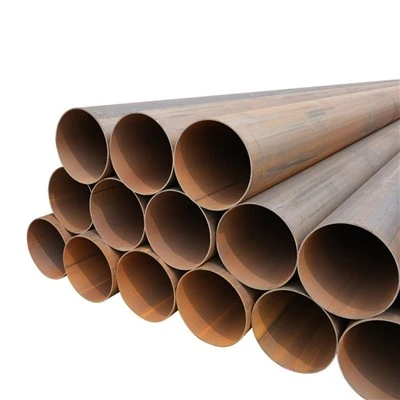
In the continuous production line of ERW (Electric Resistance Welded) steel pipes, after the steel pipes are welded, internal and external burrs are removed, and necessary heat treatment is performed, it does not mean they are ready for delivery. At this time, the steel pipes may still have certain deviations in shape and size. Straightening and roundness calibration are the key steps for ERW steel pipes to move from being "welded" to "qualified".
Although this link does not directly change the chemical composition or microstructure of the steel pipe, it plays a decisive role in the geometric accuracy, appearance quality, and subsequent service performance of the finished product.
I. Why Do ERW Steel Pipes Need Straightening and Roundness Calibration?
During the production process of ERW steel pipes, they undergo multiple forming, welding, and heat treatment processes. Affected by the following factors, the steel pipes will inevitably have certain deformations:
- Uneven stress during steel strip forming
- Residual stress after welding and heat treatment
- Differential Shrinkage during cooling process
- Minor bending during transportation and flipping
Common problems include:
- Pipe misalignment
- Localized bending or waviness
- Excessive ovality at pipe ends
- Instability in roundness
If not subjected to straightening and roundness calibration, these problems will directly affect the installation, welding alignment, pressure-bearing capacity, and engineering appearance of the steel pipe, and may even cause the entire batch of products to fail the dimensional inspection.


II. Basic Principle of the Straightening Process
1. Core Purpose of Straightening
Straightening mainly targets the axis straightness of the steel pipe, and its goals are:
- Eliminate overall or local bending
- Make the steel pipe axis as close to the theoretical straight line as possible
- Ensure uniform stress on the entire steel pipe
2. Implementation Method of Straightening
In the ERW steel pipe production line, straightening is usually completed by a multi-roll straightener. Its basic working principle is:
- Apply reverse micro-plastic deformation to the steel pipe
- Through multiple alternating bendings
- Gradually offset the original bending stress
Straightening is not a one-time straightening but a gradual stress redistribution process, which requires high equipment precision and operational experience.
III. Function and Characteristics of the Roundness Calibration Process
If straightening solves the problem of "straightness", then roundness calibration focuses on "roundness".
1. Primary Purpose of Roundness Calibration
Roundness calibration mainly targets the cross-sectional geometric shape of the steel pipe, and its core goals include:
- Control the outer diameter size of the steel pipe
- Reduce ovality
- Improve roundness consistency
- Enhance the appearance of the steel pipe
Especially for ERW steel pipes that need to be socketed, butt-welded, or anti-corrosion treated later, good roundness is a basic condition.
2. Implementation Method of Roundness Calibration
Roundness calibration is usually completed by a sizing mill or a roundness calibration machine, and its working methods include:
- Multiple rolls evenly distributed around the circumference of the steel pipe
- Apply balanced pressure to the outer diameter of the steel pipe
- Make the cross-section gradually approach the ideal circle
During this process, slight plastic deformation occurs on the surface of the steel pipe, thereby achieving precise adjustment of size and shape.
IV. Impact of Straightening and Roundness Calibration on Steel Pipe Quality
1. Improve Dimensional Accuracy
Through straightening and roundness calibration, the following indicators of ERW steel pipes can be stably controlled within the standard requirements:
- Straightness
- Outer diameter tolerance
- Ovality indices
These are essential foundations for third-party testing and customer acceptance.
2. Improve Installation and Construction Adaptability
Straight and round steel pipes perform more stably in practical engineering:
- Easier alignment
- Uniform welding gap
- Low on-site adjustment cost
This is particularly important for pipeline engineering and structural engineering.
3. Benefits for Subsequent Processes
A good geometric shape has an obvious positive impact on subsequent processes:
- Flatter pipe cutting end face
- More stable groove processing
- More uniform anti-corrosion coating thickness
From the perspective of overall production efficiency and yield, straightening and roundness calibration are indispensable quality assurance steps.
V. Key Factors Affecting the Effect of Straightening and Roundness Calibration
1. Roll Profile and Roll Pitch Design
Whether the roll profile is reasonable directly determines the effect of straightening and roundness calibration. Mismatched roll profiles are likely to cause:
- Local indentation
- Dimensional rebound
- Unstable shape
2. Adjustment Precision and Operational Experience
Even if the equipment performance is good, improper setting of operating parameters may lead to insufficient straightening or excessive deformation. This is why mature production lines are often equipped with experienced technical personnel.
3. Steel Pipe Material and Wall Thickness
ERW steel pipes of different steel grades and wall thicknesses have differences in yield strength and springback characteristics. The parameters for straightening and roundness calibration need to be adjusted accordingly, and cannot be generalized.
VI. Does Straightening and Roundness Calibration Affect Steel Pipe Performance?
Within a reasonable process range, straightening and roundness calibration belong to cold working micro-plastic deformation, which will not adversely affect the chemical composition and overall mechanical properties of the steel pipe.
On the contrary, by eliminating residual stress concentration areas, it helps the steel pipe perform more stably during service.
Conclusion
In the production chain of ERW steel pipes, although straightening and roundness calibration are not as "prominent" as welding and heat treatment, they are key links that determine the final shape and service experience of the steel pipe. They make the steel pipe not only "well-welded" but also "straight in appearance and stable in use".
For ERW steel pipe manufacturers that truly value product consistency and engineering adaptability, straightening and roundness calibration are never a formality but an indispensable checkpoint in finished product quality control.