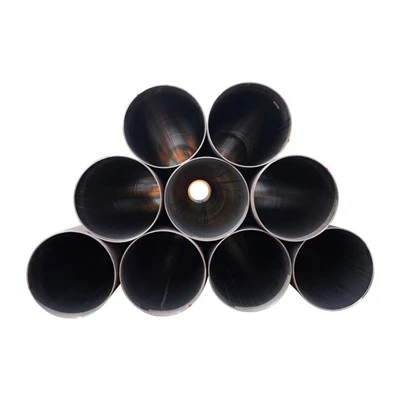
Longitudinal Submerged Arc Welded carbon steel pipe is often associated with large-diameter transmission systems, but its true engineering value becomes most visible when operating under extreme service conditions. From high-pressure gas corridors crossing mountains to low-temperature oil pipelines in cold regions, LSAW carbon steel pipe must perform reliably despite mechanical, thermal and environmental stress. Understanding how carbon steel behaves under these conditions allows engineers, EPC contractors and project owners to make technically sound decisions when selecting pipe systems.
Material Behavior of Carbon Steel Under Extreme Conditions
High Pressure Internal Loading
In high-pressure service, the dominant stress acting on a pipeline is hoop stress generated by internal pressure. For LSAW carbon steel pipe, hoop stress capacity is primarily governed by yield strength and wall thickness. Because LSAW manufacturing uses plate rather than coil, it allows for thicker wall sections and higher strength grades, enabling the pipe to handle elevated pressure with controlled deformation.
Higher grade carbon steel such as API 5L X60, X65 or X70 improves pressure containment capacity while maintaining weldability. The submerged arc weld seam, executed both internally and externally, ensures full penetration and uniform strength across the longitudinal joint. Unlike some spiral configurations, the straight seam simplifies stress distribution analysis and fracture mechanics assessment.
The table below summarizes pressure-related performance parameters for common LSAW carbon steel grades.
| Grade | Minimum Yield Strength MPa | Typical Wall Thickness mm | High-Pressure Application Suitability |
|---|---|---|---|
| X52 | 360 | 6–20 | Medium pressure oil lines |
| X60 | 415 | 8–30 | High-pressure gas pipelines |
| X65 | 450 | 10–35 | Cross-country transmission |
| X70 | 485 | 12–40 | Long-distance trunk lines |
This demonstrates how increasing strength grade and thickness enhance resistance to internal pressure without compromising structural integrity.
Low Temperature Toughness and Fracture Resistance
Carbon steel pipelines operating in cold climates must maintain adequate impact toughness to prevent brittle fracture. LSAW carbon steel pipes are typically subjected to Charpy impact testing to confirm absorbed energy values at specified temperatures. Thermomechanical controlled processing of plate steel improves grain refinement, resulting in enhanced toughness even at sub-zero temperatures.
In northern onshore gas fields and high-altitude transmission routes, low-temperature toughness becomes a decisive factor. Properly specified LSAW carbon steel pipes can maintain fracture resistance at temperatures as low as minus 40 degrees Celsius, depending on grade and treatment. This ensures operational safety during sudden pressure fluctuations or mechanical impact events.
Structural Adaptability Across Challenging Terrain
Mountainous and Seismic Regions
Pipelines crossing mountainous or seismic zones are exposed not only to internal pressure but also to ground movement, bending stress and potential soil displacement. LSAW carbon steel pipe performs well in these environments due to its combination of strength and ductility. Carbon steel's ability to deform plastically before failure provides a margin of safety when ground strain occurs.
The longitudinal seam orientation also simplifies weld inspection and integrity monitoring in such dynamic conditions. Engineers can more easily assess crack propagation risk along a straight seam compared to more complex geometries.
Long Span and River Crossings
In river crossings or above-ground spans, pipelines may experience additional bending and tensile forces. LSAW carbon steel pipes, with their thicker wall capability and dimensional precision, provide predictable load-bearing performance. The uniform geometry reduces stress concentration at joints and supports structural analysis for unsupported spans.

The table below highlights environmental and structural stress considerations in extreme terrain applications.
| Environment | Dominant Stress Type | Key Carbon Steel Requirement | LSAW Advantage |
|---|---|---|---|
| High Pressure Gas | Hoop stress | High yield strength | Thick wall capability |
| Cold Climate | Brittle fracture risk | High impact toughness | TMCP plate quality |
| Seismic Area | Bending and strain | Ductility and weld integrity | Straight seam inspection |
| River Crossing | Tensile and bending | Structural stiffness | Dimensional precision |
These factors illustrate why LSAW carbon steel pipe is frequently selected for demanding infrastructure corridors.

Corrosion and Protective Engineering in Harsh Conditions
Carbon steel in aggressive environments requires systematic corrosion protection. In desert, coastal or chemically active soil conditions, pipelines face accelerated corrosion risk. LSAW pipes are commonly supplied with multilayer polyethylene or polypropylene coatings, as well as internal epoxy lining for flow efficiency and protection.
In offshore or high-salinity soil, cathodic protection systems are installed to mitigate electrochemical corrosion. Carbon steel remains economically attractive because it integrates effectively with these protection technologies while maintaining mechanical robustness.
When properly protected, LSAW carbon steel pipelines can achieve service lives exceeding 25 to 30 years with controlled maintenance schedules.
Manufacturing Precision and Quality Assurance
The performance of LSAW carbon steel pipe in extreme environments depends heavily on manufacturing quality control. Ultrasonic testing of the weld seam, radiographic inspection, hydrostatic pressure testing and dimensional calibration ensure that each pipe meets strict standards.
Because LSAW pipes are fabricated from discrete plates, material traceability is maintained throughout production. This traceability is particularly important in high-risk applications such as high-pressure gas transmission or environmentally sensitive zones.
Manufacturers supplying critical infrastructure projects typically follow API 5L, ISO and project-specific quality management protocols to guarantee consistent mechanical performance.
Lifecycle Reliability and Risk Mitigation
From a project owner perspective, the selection of LSAW carbon steel pipe for extreme environments is closely tied to risk management. The combination of controlled welding, high-grade carbon steel plate and advanced inspection methods reduces the probability of in-service failure. While initial material cost may be higher than lighter pipe solutions, lifecycle economics favor LSAW systems in demanding conditions.
Reduced maintenance frequency, lower failure risk and enhanced structural predictability translate into long-term operational stability. For pipelines transporting natural gas, crude oil or refined products across challenging landscapes, this reliability becomes a strategic asset rather than merely a material specification.
Conclusion
LSAW carbon steel pipe demonstrates its true engineering value when subjected to extreme service environments. Its ability to withstand high internal pressure, maintain toughness at low temperatures, and adapt to complex terrain conditions makes it a cornerstone of modern energy infrastructure.
By combining high-quality carbon steel plate with longitudinal submerged arc welding and rigorous quality control, LSAW manufacturing provides a pipe system capable of balancing strength, ductility and long-term durability. In demanding pipeline applications where environmental stress and operational risk intersect, LSAW carbon steel pipe remains one of the most technically reliable solutions available in today's global infrastructure market.