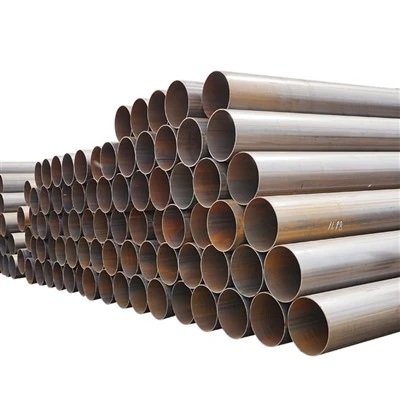
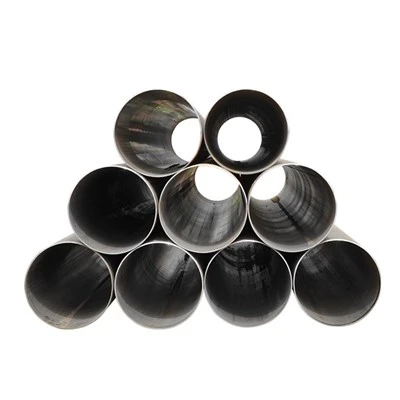
Longitudinal Submerged Arc Welded steel pipe, commonly known as LSAW steel pipe, is widely used in large-diameter pipeline projects because of its strong structural performance, reliable weld quality, and flexible manufacturing capability. The production process is fundamentally different from that of ERW or HFW steel pipe because LSAW pipe is manufactured from steel plate rather than continuously formed steel coil.
For oil and gas transmission, water transportation, petrochemical facilities, power plants, marine infrastructure, and other large-scale engineering projects, understanding the LSAW steel pipe manufacturing process is important when evaluating product quality and project suitability. Every stage, from steel plate inspection and edge preparation to forming, submerged arc welding, expansion, testing, and final inspection, contributes to the performance of the finished pipe.
Huayang Steel Pipe manufactures LSAW steel pipe for international pipeline and industrial applications. Its LSAW production range covers large outside diameters and heavy wall thicknesses, with products manufactured according to standards such as API 5L, ASTM A671, ASTM A672, ASTM A252, EN standards, and GB/T 9711. Depending on project requirements, LSAW steel pipe can also receive external and internal anti-corrosion treatment.
| Production Stage | Main Process | Quality Control Focus |
|---|---|---|
| 1 | Steel Plate Inspection | Chemical composition, mechanical properties, surface condition |
| 2 | Edge Milling | Plate width, edge geometry, groove accuracy |
| 3 | Pre-Bending | Plate curvature and forming accuracy |
| 4 | JCOE / UOE Forming | Pipe diameter and roundness |
| 5 | Tack Welding | Edge alignment and temporary joint quality |
| 6 | Submerged Arc Welding | Weld penetration and weld integrity |
| 7 | Mechanical Expansion | Diameter, roundness, dimensional accuracy |
| 8 | NDT and Testing | Ultrasonic, hydrostatic and dimensional inspection |
| 9 | Final Inspection | Surface, ends, marking and documentation |
How Does the LSAW Steel Pipe Production Process Begin?
The production of LSAW steel pipe begins with carefully selected steel plate. Because the plate forms the main body of the finished pipe, its quality directly influences the mechanical properties and weldability of the product.
Why Is Steel Plate Inspection Important?
Before entering the production line, steel plates are checked against the project specification. Chemical composition and mechanical properties are reviewed to confirm that the material is suitable for the required steel grade.
Surface condition is also inspected because excessive defects, laminations, or other imperfections can affect subsequent forming and welding operations. Material identification and traceability are maintained throughout the production process.
How Does Edge Milling Prepare the Plate?
After inspection, the plate edges are mechanically processed to achieve the required geometry.
Accurate edge preparation is essential because the two longitudinal edges must be aligned precisely during forming and welding. Controlled edge dimensions help improve welding stability and contribute to consistent weld penetration.


How Is Steel Plate Formed into an LSAW Pipe?
After preparation, the flat steel plate must be transformed into a cylindrical shape. Different forming methods can be used depending on the pipe diameter, wall thickness, and production equipment.
What Is the JCOE Forming Process?
In JCOE forming, the steel plate is progressively pressed into a J-shaped profile, followed by a C-shaped and then an O-shaped configuration. The controlled forming sequence gradually transforms the flat plate into a nearly circular pipe shape.
This method is particularly suitable for producing large-diameter LSAW steel pipes because forming parameters can be adjusted according to different pipe diameters and wall thicknesses.
Why Is Forming Accuracy Important?
Proper forming determines the initial roundness and dimensional stability of the pipe.
If edge alignment or forming geometry is inconsistent, it can affect subsequent welding and final dimensional accuracy. Therefore, forming equipment and process parameters need to be carefully controlled during production.
How Does Submerged Arc Welding Join the Pipe?
After forming, the longitudinal seam is welded using Submerged Arc Welding, or SAW technology. This is one of the defining characteristics of LSAW steel pipe production.
Why Is Submerged Arc Welding Used?
During SAW, the welding arc operates beneath a layer of granular flux. The flux protects the molten weld pool from atmospheric contamination while helping maintain stable welding conditions.
Depending on the production system, both internal and external welding operations can be performed. The controlled welding environment allows manufacturers to achieve deep penetration and stable weld formation.
What Factors Affect Weld Quality?
Welding current, voltage, travel speed, flux condition, welding wire, edge preparation, and joint alignment can all influence weld quality.
Professional production therefore requires continuous monitoring of welding parameters. After welding, non-destructive testing is used to verify the integrity of the longitudinal seam.
Why Is Mechanical Expansion Used After Welding?
Once welding is completed, the pipe may undergo mechanical expansion to improve dimensional accuracy.
How Does Expansion Improve Pipe Geometry?
The expansion process applies controlled mechanical force to adjust the pipe diameter and roundness.
This operation helps compensate for dimensional deviations created during plate forming and welding. It also improves consistency between individual pipe sections, which is important for field installation.
Why Does Roundness Matter in Pipeline Construction?
Consistent pipe geometry makes it easier to align adjacent pipe sections during field welding.
Improved dimensional accuracy can reduce installation adjustments and contribute to more efficient construction, particularly on large pipeline projects involving thousands of pipe sections.
How Are Finished LSAW Steel Pipes Tested?
Testing is an essential stage of the manufacturing process because visual inspection alone cannot verify the integrity of a welded pipe.
Which Non-Destructive Tests Are Commonly Used?
Depending on the applicable standard and customer specification, LSAW steel pipes may undergo ultrasonic testing, radiographic testing, hydrostatic testing, dimensional inspection, and visual examination.
Ultrasonic testing can detect internal imperfections, while hydrostatic testing verifies the pipe's pressure resistance under controlled conditions.
What Happens During Final Inspection?
The finished pipe is checked for outside diameter, wall thickness, length, straightness, ovality, end condition, surface quality, and marking.
Inspection documentation is also prepared to provide traceability for the material, production process, testing results, and final product.
How Can Anti Corrosion Coating Be Added After Production?
For pipelines exposed to soil, groundwater, seawater, or industrial environments, additional corrosion protection may be required.
Which Coating Systems Are Available?
LSAW steel pipe can be supplied with external coating systems such as FBE, 2PE, 3PE, 2PP, and 3PP, while internal epoxy coatings can be used for selected applications.
The coating process normally includes surface preparation, heating or primer application where required, coating application, curing, and final inspection. Proper surface preparation and coating thickness control are important for long-term corrosion protection.
Project Reference: LSAW Steel Pipe for a Chilean Copper Mine Project
The Chilean copper mine project provides an example of LSAW steel pipe used in international pipeline engineering. In July 2024, Huayang Steel Pipe supplied approximately 1,413 tons of LSAW steel pipe manufactured to API 5L PSL1 Grade B, with a specification of 914 × 15.88 mm.
The pipes were used for pipeline engineering associated with the copper mining project. The relatively large diameter and substantial wall thickness required stable plate forming, reliable longitudinal submerged arc welding, accurate dimensional control, and comprehensive inspection. This project demonstrates how LSAW steel pipe manufacturing technology can support demanding industrial infrastructure in the mining sector.
Read More:
How Does HFW Steel Pipe Support Reliable Oil And Gas Pipeline Construction?
Why Is LSAW Steel Pipe The Best Solution For Large Diameter Foundation Piling Projects?