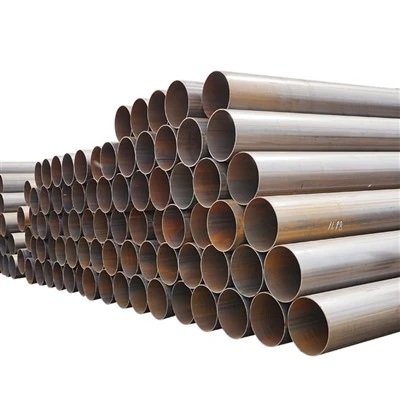
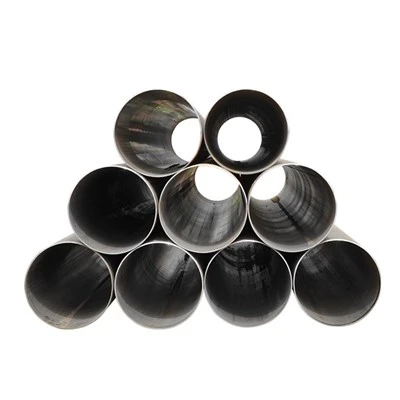
High Frequency Welded steel pipe, commonly known as HFW steel pipe, is an important welded steel pipe product widely used in oil and gas transportation, water supply systems, industrial pipelines, and structural engineering. The manufacturing process of HFW steel pipe combines continuous forming technology, high-frequency welding technology, precision sizing, and strict quality inspection to produce steel pipes with stable dimensions and reliable mechanical performance.
The production of HFW steel pipe begins with high-quality hot-rolled steel coils. During manufacturing, the steel strip is continuously uncoiled, leveled, formed into a round pipe shape through forming rollers, and welded along the longitudinal seam by high-frequency electrical resistance welding. The welded pipe then undergoes sizing, straightening, inspection, and surface treatment processes to ensure that the finished product meets international standards and project requirements.
Compared with traditional welding methods, HFW technology provides high production efficiency and consistent weld quality. The controlled welding process creates a narrow heat-affected zone and helps maintain the mechanical properties of the base material. Huayang Steel Pipe manufactures HFW steel pipe according to international standards such as API 5L, ASTM A53, ASTM A500, EN 10219, EN 10217, and GB/T standards, with production capabilities covering Φ48–Φ660.4 mm outside diameter, 2.0–22 mm wall thickness, and customized lengths from 6 m to 27 m.
| Item | HFW Steel Pipe Manufacturing and Application |
|---|---|
| Manufacturing Process | High Frequency Resistance Welding |
| Raw Material | Hot Rolled Steel Coil |
| Diameter Range | Φ48–Φ660.4 mm |
| Wall Thickness | 2.0–22 mm |
| Production Standards | API 5L, ASTM A53, ASTM A500, EN 10219, EN 10217 |
| Welding Method | High Frequency Electrical Resistance Welding |
| Main Applications | Oil & Gas Pipeline, Water Transmission, Industrial Pipeline, Construction |
How Is HFW Steel Pipe Manufactured Step by Step?
The manufacturing process directly determines the quality, performance, and service life of HFW steel pipe. Each production stage requires accurate control to ensure the final product meets technical specifications.
How Does Steel Coil Preparation Affect HFW Pipe Quality?
The production process begins with selecting qualified hot-rolled steel coils. Before entering the forming line, the raw material is inspected to verify chemical composition, mechanical properties, surface condition, and dimensional accuracy.
The steel coil is then uncoiled and leveled to remove deformation caused during storage and transportation. A stable and flat steel strip provides a better foundation for the subsequent forming and welding processes.
Why Is Raw Material Control Important?
The chemical composition and mechanical properties of steel determine the pipe's strength, toughness, and weldability.
For pipeline applications, especially oil and gas transportation, selecting steel coils that meet the required standard is essential for ensuring reliable operation under pressure and environmental conditions.


How Does High Frequency Welding Form a Reliable Pipe Joint?
After leveling, the steel strip enters the forming section where a series of rollers gradually bends the flat strip into a circular pipe shape.
What Happens During the HFW Welding Process?
When the strip edges approach each other, high-frequency electrical current is applied to generate concentrated heat at the edge surfaces. The heated edges are then pressed together through squeeze rollers, creating a longitudinal weld.
Unlike welding processes that use additional filler materials, HFW relies on resistance heating and pressure to form the joint. This allows the weld area to maintain consistent characteristics with the surrounding steel.
How Is Welding Quality Controlled?
During production, welding parameters including frequency, power, welding speed, and squeeze pressure are continuously monitored.
After welding, the pipe passes through sizing and straightening equipment to improve dimensional accuracy. Advanced inspection methods such as ultrasonic testing and hydrostatic testing can be applied according to the required standard and customer specifications.
Where Are HFW Steel Pipes Commonly Used?
Due to their excellent dimensional accuracy and efficient manufacturing characteristics, HFW steel pipes are widely applied in various engineering fields.
How Are HFW Steel Pipes Used in Oil and Gas Transportation?
Oil and gas pipelines require steel pipes with reliable pressure resistance and stable weld performance. HFW steel pipe manufactured according to API 5L requirements can be used in many medium-diameter pipeline systems, including gathering pipelines, distribution networks, and industrial energy transportation systems.
The accurate dimensions of HFW pipe help improve installation efficiency during pipeline construction. Consistent outside diameter and wall thickness make field connection and welding operations more convenient.
Why Is HFW Pipe Suitable for Energy Infrastructure?
Energy projects often require large quantities of steel pipes delivered within strict construction schedules. The continuous production characteristics of HFW technology allow manufacturers to provide stable supply capacity while maintaining consistent product quality.
How Does HFW Steel Pipe Support Water Transmission Projects?
Water pipeline systems require corrosion-resistant and durable steel pipes to ensure long-term operation.
What Advantages Does HFW Pipe Provide for Water Pipelines?
HFW steel pipe offers smooth internal surfaces, accurate dimensions, and good mechanical strength, making it suitable for municipal water supply, industrial water transportation, and water treatment projects.
Depending on the application environment, HFW steel pipes can be supplied with protective coatings such as FBE, 3PE, 3PP, or internal epoxy coating to improve corrosion resistance and extend service life.
Why Is Coating Important for Underground Pipelines?
Underground pipelines are exposed to moisture, soil chemicals, and other corrosive factors.
Appropriate external coating systems create a protective barrier between the steel surface and the surrounding environment, helping reduce corrosion risks and lowering future maintenance requirements.
How Is HFW Steel Pipe Used in Industrial and Structural Applications?
Beyond energy and water pipelines, HFW steel pipe is also used in industrial facilities and structural projects.
What Industrial Applications Require HFW Steel Pipe?
HFW steel pipes can be used in industrial fluid transportation systems, equipment support structures, mechanical applications, and general engineering projects.
Their dimensional consistency and efficient manufacturing process make them suitable for projects requiring reliable steel pipe supply with controlled specifications.
How Does Precision Manufacturing Benefit Construction?
In structural applications, accurate dimensions improve assembly efficiency and reduce installation difficulties.
For industrial projects with strict engineering requirements, consistent pipe quality helps contractors complete construction more efficiently while maintaining structural reliability.
How Do Manufacturers Ensure HFW Steel Pipe Reliability?
Reliable HFW steel pipe requires strict quality control throughout the entire production process.
Which Tests Are Performed Before Delivery?
Depending on customer requirements and applicable standards, finished HFW steel pipes may undergo dimensional inspection, mechanical testing, ultrasonic inspection, hydrostatic testing, visual examination, and surface inspection.
These tests verify that the pipe meets requirements related to strength, weld integrity, and dimensional tolerance.
Why Is Quality Documentation Important?
For international engineering projects, complete inspection records and material certificates provide traceability.
Documentation allows project owners and contractors to confirm that supplied steel pipes meet the specified standards and quality requirements.
Project Reference: HFW Steel Pipe for Turkmenistan Power Plant Project
The Kiyanly 1574 MW Combined Cycle Power Plant Project in Turkmenistan is an example of HFW steel pipe applied in international energy infrastructure.
For this project, Huayang Steel Pipe supplied steel pipes manufactured according to API 5L Grade B PSL1 and ASTM A672 Grade B60 CL22, covering specifications from 508 mm to 1016 mm, with a total quantity of approximately 538 tons.
The project required reliable steel pipe products for power plant pipeline systems. Through controlled HFW production technology, strict quality inspection, and compliance with international standards, the supplied pipes supported the construction requirements of this large-scale energy facility.
Read More:
How Is LSAW Steel Pipe Manufactured? A Step-by-Step Guide To The Production Process
How Does HFW Steel Pipe Support Reliable Oil And Gas Pipeline Construction?