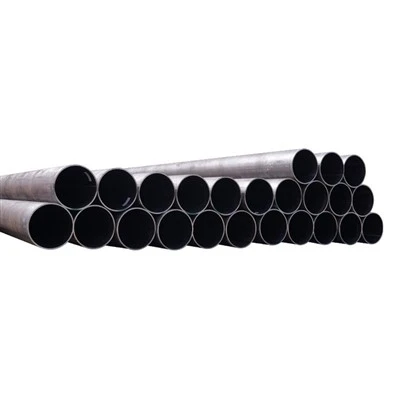
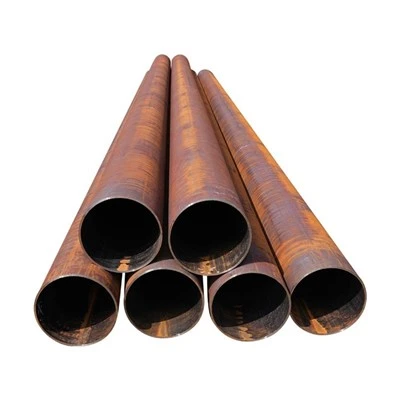
In the field of carbon steel pipe manufacturing, welding technology plays a decisive role in determining product performance, cost structure, and application range. Two common welded pipe types are ERW, which stands for Electric Resistance Welding, and EFW, meaning Electric Fusion Welding. Although both processes produce longitudinally welded steel pipes, their welding principles, material thickness capability, inspection requirements, and application scenarios differ significantly. Understanding the technical differences between ERW carbon steel pipe and EFW pipe helps engineers and procurement professionals select the most appropriate product for specific pressure, temperature, and structural conditions.
Overview of ERW Welding Technology
High-Frequency Resistance Welding Principle
ERW pipe is manufactured by cold-forming steel strip into a cylindrical shape and then applying high-frequency electrical current to heat the edges of the strip. The heat generated by electrical resistance raises the temperature of the contacting edges to a plastic state. Mechanical pressure is then applied, forging the edges together to create a solid-phase weld without adding filler metal.
Because ERW welding relies on resistance heating and pressure rather than external filler material, the weld seam is narrow and metallurgically similar to the base metal after proper heat treatment. Modern ERW production lines incorporate seam normalization processes that refine the heat-affected zone, ensuring uniform mechanical properties across the pipe wall.
Thickness and Diameter Range
ERW carbon steel pipes are typically produced in small to medium diameters, commonly up to 24 inches depending on manufacturing capability. Wall thickness is generally moderate, as the process is optimized for strip-based production. The method is highly efficient for high-volume manufacturing, making ERW pipe cost-effective for water supply, gas distribution, and structural applications.
The following table summarizes core characteristics of ERW pipe manufacturing.
| Parameter | ERW Pipe Characteristics |
|---|---|
| Welding Method | High-frequency resistance heating |
| Filler Metal | Not used |
| Typical Diameter Range | Small to medium sizes |
| Wall Thickness Range | Thin to moderate |
| Production Efficiency | High for continuous production |
| Common Applications | Water, gas, structural use |
These features make ERW carbon steel pipe particularly suitable for standardized infrastructure systems.
Overview of EFW Welding Technology
Electric Fusion Welding Process
EFW pipe is produced using electric arc welding techniques, where the edges of steel plate or sheet are melted together using an electric arc. In most cases, filler metal is added to create a fully penetrated weld. The process can involve single or multiple welding passes depending on material thickness.
Unlike ERW welding, EFW involves melting the base metal and filler material to create a fusion bond. Because the process relies on arc energy, it is capable of joining thicker plates and larger diameters. This makes EFW suitable for heavy-wall pipes used in high-pressure or high-temperature applications.


Material Thickness Capability
EFW manufacturing is commonly applied to thicker carbon steel plates, often exceeding the practical thickness limits of ERW processes. The ability to perform multiple welding passes ensures deep penetration and structural reliability in demanding environments. As a result, EFW pipes are frequently used in petrochemical plants, power generation facilities, and process piping systems where strength and durability are critical.
The following table compares technical differences between ERW and EFW pipes.
| Comparison Factor | ERW Pipe | EFW Pipe |
|---|---|---|
| Heat Source | Electrical resistance | Electric arc fusion |
| Welding State | Solid-phase forging | Melted fusion with filler |
| Wall Thickness Suitability | Thin to medium | Medium to thick |
| Production Speed | Continuous high speed | Slower, multi-pass possible |
| Cost Level | Generally lower | Generally higher |
| Typical Use | Distribution pipelines | Heavy industrial systems |
These distinctions clarify why each method serves different engineering needs.
Mechanical and Structural Differences
Weld Seam Characteristics
In ERW carbon steel pipe, the weld seam is narrow and, after heat treatment, closely matches the mechanical properties of the parent material. Because no filler metal is used, chemical composition remains consistent across the seam. This uniformity contributes to predictable strength and ductility in moderate pressure applications.
In contrast, EFW weld seams involve filler metal and multiple passes, which may create a wider heat-affected zone. While this increases manufacturing complexity, it also enables full penetration welds in thick materials. Rigorous non-destructive testing such as radiographic or ultrasonic inspection is typically required to ensure weld quality in EFW production.
Pressure and Temperature Capability
ERW pipes are well suited for low to medium pressure systems, including water supply networks and natural gas distribution lines. Their performance is reliable when wall thickness and diameter remain within standard limits.
EFW pipes are commonly selected for high-pressure and high-temperature environments, particularly where thick-wall carbon steel pipe is required. The fusion welding process accommodates larger diameters and heavy sections, making it appropriate for refinery piping and power plant systems.
Cost and Production Considerations
ERW manufacturing is characterized by continuous strip forming, which supports large-scale output with consistent dimensional control. The absence of filler material and multi-pass welding reduces production time and overall cost. This economic efficiency explains why ERW carbon steel pipe dominates municipal and distribution applications.
EFW production, on the other hand, involves plate forming and arc welding, often requiring multiple weld passes and additional inspection procedures. The process is more labor-intensive and energy-consuming, leading to higher production costs. However, for applications requiring thick walls or large diameters, the structural advantages justify the expense.
Selection Guidance for Engineering Projects
Choosing between ERW and EFW pipe depends on operating pressure, wall thickness requirements, project budget, and regulatory standards. For small to medium diameter pipelines transporting water or gas at moderate pressures, ERW carbon steel pipe offers sufficient strength with cost efficiency. For heavy industrial systems requiring thick-wall construction or high temperature resistance, EFW pipe may be more suitable.
Engineers must also consider inspection requirements and code compliance. Some industrial standards specify welding methods for certain service conditions. Therefore, material selection should align with design calculations and applicable specifications.
Conclusion
The difference between ERW and EFW lies primarily in their welding techniques and resulting structural capabilities. ERW utilizes high-frequency resistance heating and pressure forging without filler metal, producing efficient and economical pipes for moderate service conditions. EFW employs electric arc fusion welding with filler material, enabling thicker walls and suitability for demanding industrial environments.
Understanding these distinctions allows engineers to match welding technology to application requirements. Both ERW and EFW carbon steel pipes play essential roles in modern infrastructure, but selecting the appropriate method ensures optimal performance, safety, and cost control in each project scenario.