


Pipe beveling is a crucial step in steel pipe manufacturing and welding preparation. It ensures that the pipe ends are properly shaped for strong, consistent, and defect-free weld joints. At Huayang Steel Pipe, beveling is part of the company's precision finishing process - ensuring every pipe leaving the factory is welding-ready for oil, gas, construction, and infrastructure projects around the world.
This article explores the different methods of pipe beveling, their applications, and how Huayang Steel Pipe uses advanced technology to guarantee beveling quality.
For a deeper understanding of beveling importance in welding, see our main article:
👉 Why Pipe Beveling is Important for Welding
Understanding Pipe Beveling Techniques
Pipe beveling refers to machining or cutting the pipe end at an angle other than 90 degrees. This angled edge allows proper weld penetration, uniform filler metal flow, and better stress distribution during welding.
Depending on the production volume, pipe thickness, and required precision, manufacturers can use manual, mechanical, thermal, or CNC-based beveling processes. Choosing the right method is key to balancing cost, speed, and weld quality.
Manual Beveling – Flexible but Labor-Intensive
Manual beveling is the most basic method, performed using hand tools such as grinders, files, or cutting torches. It is commonly used for small-batch fabrication or on-site pipeline repair when heavy machinery is unavailable.
Manual beveling provides flexibility for irregular pipe sizes or when slight adjustments are required before field welding. However, it is time-consuming and lacks the precision of mechanized methods.
Comparison Between Manual and Mechanical Beveling
| Parameter | Manual Beveling | Mechanical Beveling |
|---|---|---|
| Precision | Moderate, depends on operator skill | High, controlled by machine |
| Speed | Slow | Fast and repeatable |
| Surface Finish | Rough | Smooth, consistent |
| Suitability | Small repairs, low-volume jobs | Mass production |
| Cost | Low initial investment | Higher equipment cost but long-term savings |
Manual beveling remains useful for repair jobs or remote site work, but large-scale manufacturers like Huayang Steel Pipe primarily rely on mechanized and CNC systems for consistency.
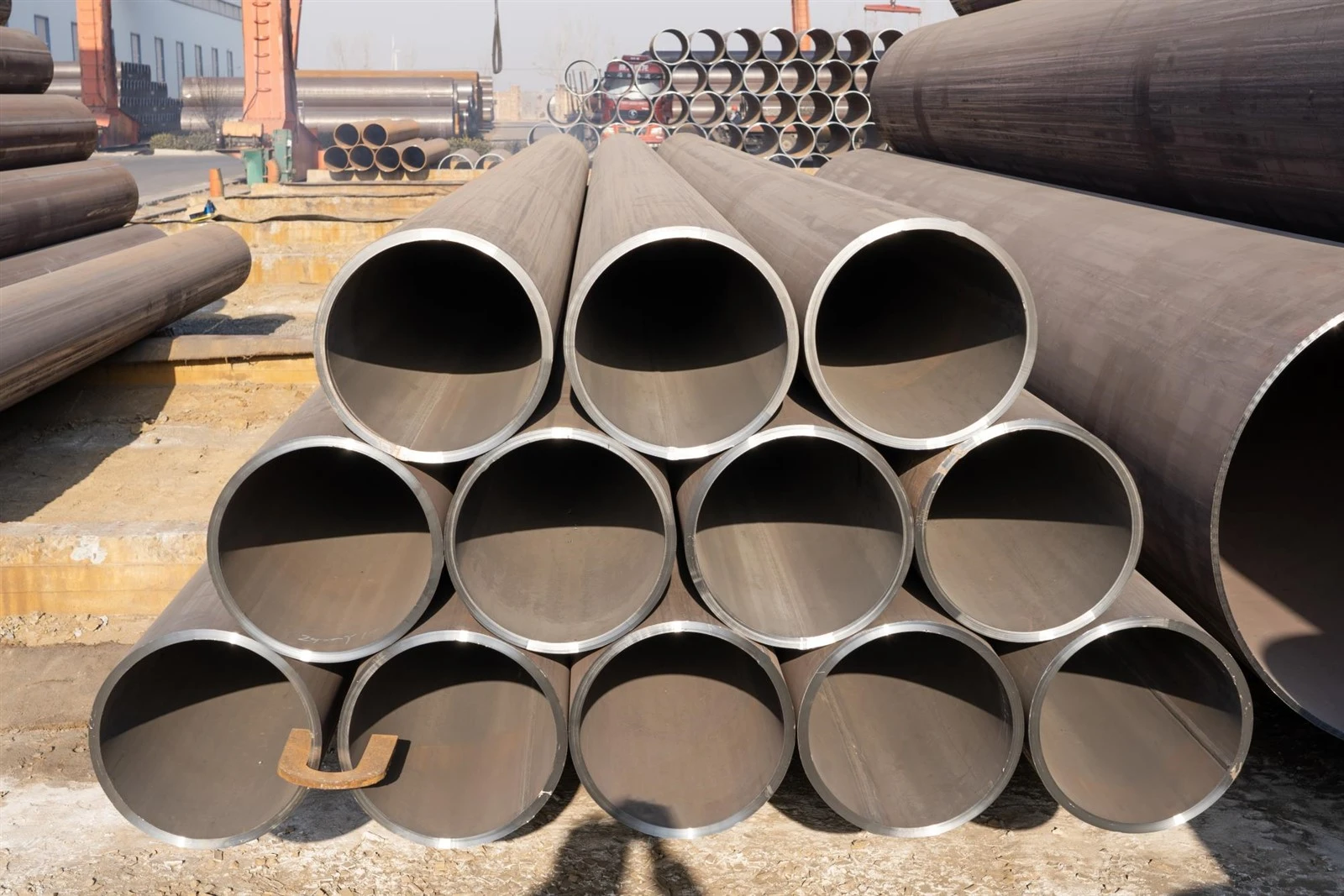

Mechanical and Lathe Beveling – Precision for Consistency
Mechanical beveling machines use rotating cutting tools or lathe-based systems to remove material from the pipe end. This approach produces a smooth and uniform bevel with tight tolerance control.
Lathe beveling, in particular, is ideal for medium- to large-diameter pipes and ensures precise angles and consistent wall thickness. The cutting speed and feed rate can be adjusted for different pipe grades, such as ASTM A106 or API 5L carbon steel pipes.
At Huayang Steel Pipe, mechanical beveling is integrated into the ERW and SAW production lines, ensuring every pipe end matches international standards like ASME B16.25 and API 5L before packaging.
Advantages of Mechanical Beveling
- High accuracy and repeatability
- Suitable for both thin and thick wall pipes
- Minimal heat generation (no effect on microstructure)
- Cleaner edges, ready for immediate welding
This process is particularly effective for industrial-grade ERW pipes produced at Huayang, where precision and repeatability are crucial for large-scale pipeline projects.
Flame and Plasma Beveling – Speed for Heavy-Duty Steel
For thick-wall or large-diameter steel pipes, thermal beveling methods such as flame cutting and plasma cutting are used. These processes apply intense heat to melt and remove material from the pipe end.
Flame beveling uses an oxy-acetylene torch, while plasma beveling relies on ionized gas at extremely high temperatures. Plasma cutting is faster and offers cleaner results but requires specialized equipment and operator training.
Comparison of Thermal Beveling Methods
| Method | Heat Source | Speed | Edge Finish | Typical Use |
|---|---|---|---|---|
| Flame Beveling | Oxy-acetylene | Moderate | Slight oxidation | Heavy-wall pipes, general fabrication |
| Plasma Beveling | Ionized gas arc | Very fast | Smooth, minimal oxidation | High-precision or alloy steel pipes |
| Mechanical Beveling | Rotating cutting tools | Controlled | Clean, cold-cut | Carbon steel pipe manufacturing |
Huayang's production lines occasionally combine mechanical and thermal techniques for custom orders, especially for clients requesting large-diameter LSAW pipes with specific bevel configurations.
CNC Beveling – The Modern Industrial Standard
As automation continues to transform steel pipe manufacturing, CNC beveling (Computer Numerical Control) has become the benchmark for precision and productivity.
CNC systems use programmable settings to achieve consistent bevel angles, root faces, and dimensions with minimal human intervention. This method reduces production time and eliminates operator error.
Key Benefits of CNC Beveling
- Automated control of angle and cutting speed
- Consistent results for large batches
- Integration with digital measurement systems
- Improved safety and efficiency
CNC beveling allows Huayang Steel Pipe to meet the highest standards for export-quality ERW and SAW pipes - ensuring every pipe end is perfectly prepared for welding in oil, gas, and infrastructure applications.
Applications of Different Beveling Methods
Each beveling technique serves specific industrial needs depending on project complexity and material type. The following table summarizes typical use cases:
| Industry | Common Beveling Method | Key Requirements |
|---|---|---|
| Oil & Gas Pipelines | CNC or Flame | Large diameters, uniform weld joints |
| Power Generation | Mechanical Lathe | Tight tolerances, heat-resistant alloys |
| Construction | Manual or Mechanical | Cost-effective, flexible fabrication |
| Shipbuilding | Plasma or Mechanical | Corrosion-resistant joints |
| Water Transmission | CNC Beveling | Smooth edges for pressure sealing |
At Huayang Steel Pipe, the beveling method is selected according to pipe grade, wall thickness, and project requirements, ensuring both cost efficiency and long-term weld reliability.
Huayang Steel Pipe's Beveling Capabilities
With decades of manufacturing experience, Huayang Steel Pipe has integrated automated beveling technology into its ERW and LSAW production lines.
Key Features:
- Pipe diameter range: Φ73–Φ1422 mm
- Wall thickness: 2.5–50 mm
- Compliance with API 5L, ASTM A53, ASTM A106, EN10219
- Advanced beveling systems with CNC and mechanical integration
- 100% inspection before export to ensure weldability
By combining precision beveling with advanced NDT inspection and surface cleaning, Huayang ensures each steel pipe meets or exceeds client expectations worldwide.
For details on beveling standards and welding preparation, explore our main feature:
👉 Why Pipe Beveling is Important for Welding
Advantages of Proper Pipe Beveling
Proper beveling provides both mechanical and operational advantages, contributing to pipe longevity and safety:
| Benefit | Description |
|---|---|
| Enhanced Weld Strength | Enables deeper weld penetration and metallurgical bonding. |
| Reduced Welding Defects | Minimizes lack of fusion, porosity, and undercut. |
| Better Alignment | Ensures accurate fit-up during on-site assembly. |
| Time and Cost Savings | Reduces rework and improves welding speed. |
| Improved Safety | Prevents stress concentration and premature failures. |
These benefits are especially critical in high-pressure pipelines and structural steel projects, where welding quality determines system performance.
Conclusion
Pipe beveling may seem like a small step, but it is a foundation for strong, safe, and durable welds. Each method - manual, mechanical, thermal, or CNC - has its role, depending on project requirements and production scale.
For modern steel pipe manufacturers like Huayang Steel Pipe, adopting advanced beveling systems ensures precise geometry, efficient assembly, and global compliance.
Whether you need ERW, LSAW, or custom beveled carbon steel pipes, Huayang delivers reliable, welding-ready products tailored to your industry's standards.
Continue reading our related guides to learn more about beveling science and applications:
👉 Why Pipe Beveling is Important for Welding
👉 How Bevel Angle Affects Weld Quality and Pipe Performance
👉 Beveling Standards, Inspection, and Quality Control in Pipe Welding


