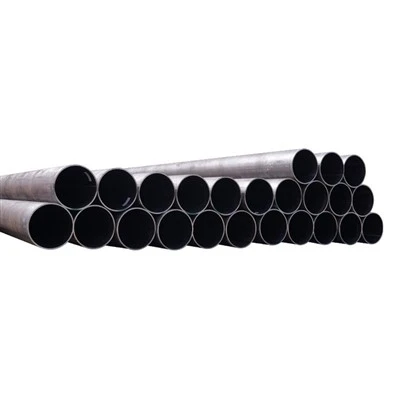
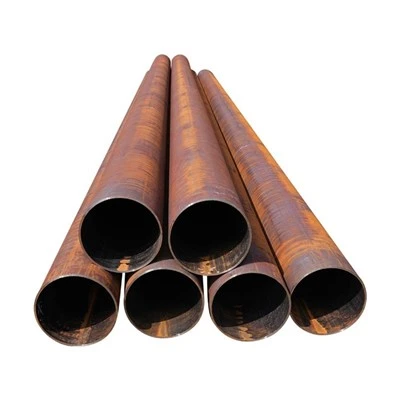
Oil and gas steel pipes go through a carefully controlled process from raw material inspection to forming, welding, testing, anti-corrosion coating, packing, and final shipment. For large diameter transmission pipelines, LSAW steel pipe is commonly produced from high-quality steel plate using JCOE forming and double-sided submerged arc welding. After strict nondestructive testing and dimensional inspection, the pipes can receive 3LPE or other protective coatings before being securely packed and loaded for transportation. This complete process ensures that the finished steel pipe meets project specifications and arrives at the job site in reliable condition.
How Does the Oil and Gas Steel Pipe Production Process Start?
The production of an oil and gas steel pipe begins long before welding. The quality of the finished pipe is closely related to the quality and condition of the incoming steel plate. For large diameter LSAW steel pipe, the selected plate must meet the specified chemical composition, mechanical properties, thickness, and surface requirements.
How Is the Steel Plate Prepared?
Before forming, steel plates are inspected and identified according to the production order. Dimensions, surface condition, plate thickness, and material grade are checked to ensure that the raw material matches the project specification.
Why Is Raw Material Inspection Important?
Oil and gas pipelines can operate under high internal pressure and demanding environmental conditions. Starting with qualified steel plate provides the foundation for subsequent forming, welding, testing, and coating processes.
After inspection, the plate edges are prepared according to the required welding procedure. Edge milling and preparation help establish the appropriate geometry for subsequent longitudinal welding.
How Is LSAW Steel Pipe Formed Using the JCOE Process?
For large diameter LSAW steel pipe, the flat steel plate must be transformed into a circular pipe shape before the longitudinal seam can be welded. JCOE is one of the important forming methods used for this purpose.
What Happens During JCOE Forming?
The steel plate is progressively pressed through multiple forming operations. The plate is first formed into a J shape, followed by C forming, and finally O forming to create the approximate circular pipe shape.
How Does JCOE Help Large Diameter Production?
Unlike continuous roll forming used in many ERW production lines, JCOE uses controlled pressing operations on individual steel plates. This provides flexibility for manufacturing large diameter steel pipe with different wall thicknesses and steel grades.
After forming, the longitudinal edges are brought into the correct position. The pipe then moves to the welding stage, where the longitudinal seam becomes the critical connection between the two sides of the plate.
Why Is Double-Sided Submerged Arc Welding Used?
Welding is one of the most important stages in LSAW steel pipe production. The longitudinal seam is normally welded using submerged arc welding, with internal and external welding performed according to the specified welding procedure.
How Does Submerged Arc Welding Work?
During submerged arc welding, the welding arc is covered by granular flux. The flux protects the welding area from atmospheric contamination while the welding wire and base metal form the required weld structure.
Why Is Double-Sided Welding Important?
Internal and external welding provides controlled weld penetration and a stable longitudinal joint. Welding parameters such as current, voltage, travel speed, heat input, wire feed, and welding sequence must be carefully controlled to maintain consistent weld quality.
For oil and gas transmission applications, the weld seam must satisfy the requirements of the applicable product standard and project specification. The welding process is therefore closely integrated with subsequent nondestructive testing and mechanical performance verification.
How Are Oil and Gas Steel Pipes Tested After Welding?
A finished weld cannot be judged only by its appearance. After welding, the pipe undergoes a series of inspections designed to identify potential defects and verify dimensional accuracy.
What Does Nondestructive Testing Check?
Nondestructive testing, commonly known as NDT, is used to examine the weld and pipe body without damaging the finished product. Depending on the applicable standard and project requirements, ultrasonic testing, radiographic testing, visual inspection, and other examination methods may be applied.
Why Are Dimensional Checks Also Necessary?
The outside diameter, wall thickness, length, straightness, roundness, and pipe ends must meet the specified tolerances. End beveling may also be performed to prepare the pipe for field welding and installation.
Hydrostatic testing can further verify pressure integrity when required by the applicable standard or project specification. These inspection stages help ensure that defects are identified before the steel pipe leaves the production facility.


Why Does Oil and Gas Steel Pipe Need Anti Corrosion Coating?
Steel pipe used for underground, underwater, or exposed pipeline systems may face moisture, soil corrosion, chemicals, and other environmental factors. An appropriate anti-corrosion coating can significantly improve protection of the external pipe surface.
How Does 3LPE Protect the Pipe?
3LPE is a three-layer polyethylene coating system consisting of a fusion bonded epoxy primer, an adhesive layer, and an external polyethylene layer. Before coating, the pipe surface is properly prepared to provide the required cleanliness and surface profile.
What Are the Main Benefits of 3LPE?
The epoxy layer provides corrosion resistance and adhesion to the steel surface. The adhesive layer strengthens the connection between the epoxy and polyethylene, while the polyethylene outer layer provides mechanical protection against moisture, soil, and external damage.
After coating, coating thickness and surface integrity are checked. Holiday testing or spark testing can be used to identify coating discontinuities where required. Proper coating inspection is particularly important because even a small defect can become a potential entry point for corrosion.
How Are Finished Pipes Packed and Prepared for Shipment?
Once production, testing, and coating are completed, the steel pipe enters the final preparation stage. Pipe ends may receive protective measures, while quantities, specifications, markings, and shipping documents are checked against the order.
How Are Pipes Loaded for Long Distance Transportation?
Large diameter steel pipes require careful loading and securing to prevent movement, collision, coating damage, or deformation during transportation. When pipes are shipped in containers, the loading arrangement must make efficient use of available space while maintaining sufficient protection.
Why Is Shipment Control Important?
Oil and gas steel pipe may travel thousands of kilometers by truck, rail, or ocean freight before reaching the project site. Proper packing, lifting, separation, and reinforcement reduce the risk of damage during handling and long-distance transportation.
For international orders, shipment preparation also includes quantity verification, product identification, inspection documentation, packing lists, and other export documents required by the customer or destination market.
How Does Huayang Control the Complete Process?
Reliable oil and gas steel pipe is the result of controlling the entire supply chain rather than focusing on welding alone. From incoming steel plate and JCOE forming to double-sided SAW welding, NDT, dimensional inspection, hydrostatic testing, anti-corrosion coating, packing, and loading, each stage contributes to the final product quality.
Huayang Steel Pipe manufactures large diameter LSAW steel pipe with diameters from Φ406.4 to Φ2,800 mm and wall thicknesses from 7 to 50 mm. The company also provides anti-corrosion processing, including 3PE, 2PE, 3PP, 2PP, FBE, internal epoxy powder, and internal liquid epoxy coating systems according to project requirements.
For oil and gas pipeline projects, production quality and delivery reliability are equally important. A complete process from qualified raw material to secure shipment helps ensure that the steel pipe not only meets the required technical specifications but also reaches the customer ready for installation. This is how an oil and gas steel pipe moves from mill to shipment with quality controlled at every stage.
Read More:
Is The Weld The Weakest Part Of Straight Welded Steel Pipes?
How Do LSAW Steel Pipe And ERW Steel Pipe Differ in Project Applications?