


A Technical White Paper on Carbon Steel Pipe Solutions
Introduction
Liquefied natural gas projects represent one of the most demanding segments of the global energy infrastructure. From upstream gas treatment to long-distance transmission and terminal processing, LNG systems operate under high pressure, strict safety margins, and long design lifecycles. While cryogenic sections require specialized alloys, a substantial portion of LNG high-pressure pipelines continues to rely on carbon steel pipes, particularly in gas transmission, process interconnections, and utility systems.
Among the available pipe manufacturing technologies, Longitudinal Submerged Arc Welded pipes have emerged as the preferred solution for many LNG high-pressure applications. This preference is not incidental but is the result of a combination of structural reliability, manufacturing control, inspection transparency, and lifecycle economics. This white paper explains why LSAW carbon steel pipes are widely selected for LNG high-pressure pipelines and how their technical characteristics align with the stringent requirements of modern LNG projects.
High-Pressure Pipeline Requirements in LNG Projects
Pressure, Safety, and Design Margins
LNG high-pressure pipelines are designed to transport natural gas at elevated pressures over long distances or within complex processing facilities. These pipelines must withstand not only internal pressure but also thermal expansion, pressure cycling, vibration, and occasional surge conditions.
Carbon steel pipes used in such systems are required to maintain stable mechanical performance throughout decades of service. Design codes typically apply conservative safety factors, which directly influence material grade selection, wall thickness, and manufacturing quality requirements. In this environment, pipe integrity is not only a mechanical issue but a system-level safety consideration.
Operational and Environmental Conditions
High-pressure LNG pipelines are often exposed to challenging external environments, including offshore platforms, coastal terminals, seismic zones, and corrosive atmospheres. Carbon steel remains a preferred material due to its predictable behavior, well-understood degradation mechanisms, and compatibility with established corrosion protection systems.
The chosen pipe manufacturing method must therefore support consistent material properties, reliable weld performance, and effective inspection throughout the pipeline lifecycle.
Structural Advantages of LSAW Carbon Steel Pipes
Longitudinal Seam Geometry and Load Distribution
LSAW pipes are produced by forming steel plates into cylindrical shapes and welding them longitudinally using submerged arc welding. This straight seam configuration provides a predictable stress distribution under internal pressure, which is especially important for thick-wall, high-pressure pipelines.
Unlike spiral-welded pipes, where the helical seam experiences combined axial and circumferential stresses, the longitudinal seam of an LSAW pipe aligns with the primary stress direction in pressure service. This alignment simplifies stress analysis and reduces uncertainty in fracture mechanics assessments for LNG pipelines.
Thick Wall Capability and Diameter Flexibility
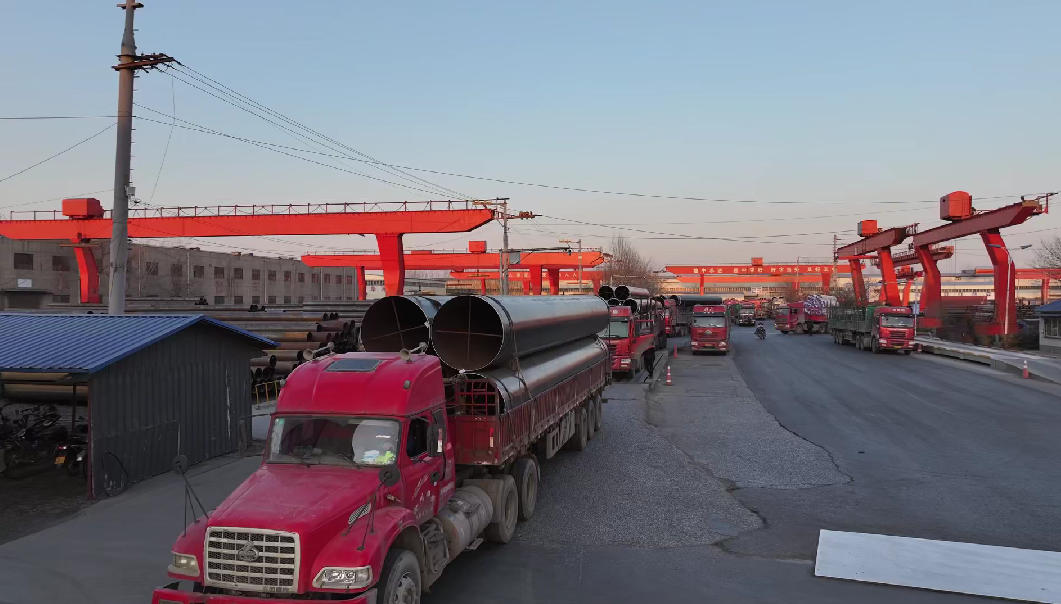
High-pressure LNG pipelines often require thick wall designs to meet pressure containment and safety requirements. LSAW manufacturing is well suited for producing pipes with larger diameters and heavier wall thicknesses than many alternative methods.
This capability allows designers to optimize pipeline dimensions without compromising manufacturability or inspection feasibility, making LSAW carbon steel pipes particularly attractive for trunk lines and critical process piping.

Manufacturing Quality and Process Control
Controlled Plate-Based Production
The use of steel plate as the starting material enables strict control over chemical composition, mechanical properties, and through-thickness quality. Plates used for LNG-grade LSAW pipes are typically produced using controlled rolling and, where necessary, thermomechanical processing to achieve balanced strength and toughness.
Because each pipe originates from a discrete plate, traceability is maintained throughout the manufacturing process. This traceability is essential for LNG projects, where material certification and auditability are mandatory.
Submerged Arc Welding and Metallurgical Consistency
Submerged arc welding offers deep penetration, stable arc characteristics, and consistent heat input. For LNG high-pressure pipelines, these attributes translate into uniform weld metal properties and a narrow, well-controlled heat-affected zone.
The resulting weld seam exhibits high strength and good toughness, closely matching the base material. This metallurgical consistency is a key reason why LSAW carbon steel pipes are trusted in safety-critical LNG applications.
Inspection, Testing, and Acceptance Transparency
Non-Destructive Testing Accessibility
One of the defining advantages of LSAW pipes is the accessibility of the longitudinal weld seam for inspection. Full-length ultrasonic testing is easily applied, allowing comprehensive detection of internal and surface defects.
Radiographic testing, where specified, can be conducted with high resolution due to the straight seam geometry. This inspection transparency aligns well with LNG project requirements for documented quality assurance and third-party verification.
Hydrostatic and Mechanical Validation
LSAW carbon steel pipes for LNG high-pressure pipelines are routinely subjected to hydrostatic testing at pressures exceeding design limits. This testing verifies not only pressure integrity but also weld soundness and dimensional stability.
Additional mechanical testing, including impact tests at reduced temperatures, provides assurance that the pipe can tolerate transient low-temperature exposure during start-up, shutdown, or abnormal operating scenarios.
Table 1: Key Technical Attributes of LSAW Carbon Steel Pipes for LNG High-Pressure Pipelines
| Attribute | Typical Performance Level | Engineering Significance |
|---|---|---|
| Wall Thickness Capability | Medium to very thick walls | High-pressure containment |
| Weld Seam Orientation | Longitudinal | Predictable stress behavior |
| Weld Inspection Coverage | 100% UT, RT as required | High reliability and acceptance |
| Dimensional Accuracy | Tight tolerances achievable | Installation and alignment efficiency |
| Material Traceability | Plate-level traceability | LNG project compliance |
Lifecycle Performance and Risk Management
Fatigue and Pressure Cycling Behavior
High-pressure LNG pipelines experience pressure fluctuations during normal operation. LSAW carbon steel pipes demonstrate favorable fatigue performance due to their uniform geometry and controlled weld properties.
The straight seam design simplifies fatigue assessment and reduces the likelihood of unexpected stress concentration, contributing to long-term operational stability.
Corrosion Protection Compatibility
Carbon steel pipes rely on external coatings and cathodic protection systems for corrosion control. LSAW pipes integrate seamlessly with these protection strategies, as their smooth external surface and consistent geometry facilitate uniform coating application.
This compatibility supports predictable corrosion behavior and simplifies maintenance planning over the pipeline lifecycle.
Economic and Project-Level Considerations
Cost Efficiency Over Project Lifecycle
While the initial procurement cost of LSAW pipes may be higher than some alternatives, their lifecycle cost is often lower in LNG high-pressure applications. Reduced inspection uncertainty, lower installation risk, and predictable long-term performance translate into measurable project savings.
From an EPC perspective, the reliability of LSAW carbon steel pipes reduces contingency allowances and supports schedule certainty.
Alignment with International LNG Standards
LSAW pipes are widely accepted under international standards such as API 5L and related project specifications. Their established track record in LNG projects worldwide simplifies approval processes and reduces the risk of late-stage technical objections.
Table 2: Comparison of Pipe Manufacturing Methods for LNG High-Pressure Applications
| Evaluation Aspect | LSAW Carbon Steel Pipe | ERW/HFW Pipe | HSAW Pipe |
|---|---|---|---|
| Suitability for High Pressure | Excellent | Limited by wall thickness | Moderate |
| Weld Stress Orientation | Longitudinal | Longitudinal | Helical |
| Inspection Transparency | High | High | Moderate |
| Thick Wall Availability | Strong capability | Limited | Moderate |
| LNG Project Acceptance | Widely preferred | Application-specific | Conditional |
Conclusion
LSAW carbon steel pipes have become the preferred choice for LNG high-pressure pipelines due to their structural reliability, manufacturing control, and inspection transparency. Their ability to accommodate thick walls, maintain predictable stress behavior, and meet stringent LNG acceptance criteria positions them as a technically robust and economically sound solution.
As LNG projects continue to expand in scale and complexity, the demand for pipeline systems that combine safety, durability, and lifecycle efficiency will only increase. Within this context, LSAW carbon steel pipes remain a cornerstone technology, supporting the safe and efficient transport of natural gas across the global LNG value chain.


