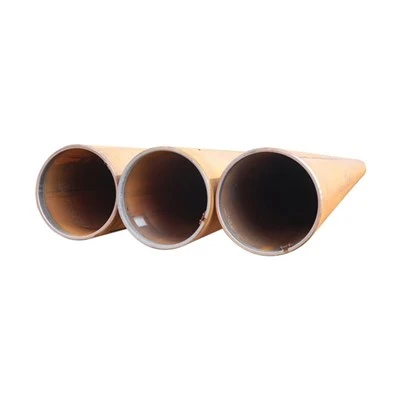
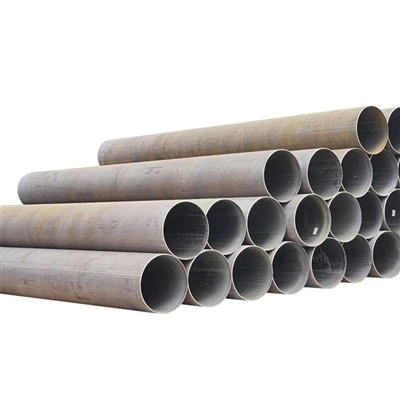
ERW steel pipe is widely used in modern construction because it combines consistent dimensions, reliable weld quality, efficient production, and competitive cost. Manufactured from steel strip through forming and high-frequency electric resistance welding, ERW steel pipe can be produced in different diameters, wall thicknesses, steel grades, and lengths to meet structural and piping requirements.
From building structures and water systems to temporary support facilities and mechanical installations, ERW steel pipe has become an important material for construction contractors and engineering companies. The following five applications represent some of the most common areas where ERW steel pipe provides practical value.
What Makes ERW Steel Pipe Suitable for Construction?
The manufacturing process is one of the main reasons ERW steel pipe is widely adopted in construction. Steel strip is continuously formed into a circular section, and the longitudinal edges are joined using electrical resistance heating. Modern high-frequency welding technology allows manufacturers to control welding parameters and produce pipes with consistent dimensions.
For construction projects, dimensional consistency is particularly important because pipes may need to be cut, connected, welded, or incorporated into larger structural assemblies. ERW production also offers high manufacturing efficiency, making it suitable for projects requiring substantial quantities of steel pipe.
What Are the Top 5 Applications of ERW Steel Pipe?
| Application | Typical Use | Key Requirements | Main Advantage of ERW Pipe |
|---|---|---|---|
| Structural Construction | Columns, frames, supports | Strength and dimensional accuracy | Efficient production and consistent dimensions |
| Water Supply Systems | Water mains and piping | Pressure performance and corrosion protection | Wide size availability |
| HVAC and Mechanical Systems | Heating and cooling piping | Dimensional accuracy and weld quality | Reliable fabrication and installation |
| Scaffolding and Temporary Structures | Scaffolding and supports | Load capacity and durability | Easy processing and economical supply |
| Industrial and Energy Facilities | Utility and process piping | Applicable standards and inspection | Customizable grades and dimensions |
1. Structural Frameworks and Building Supports
ERW steel pipe is frequently used in structural construction, particularly where tubular sections are required for columns, frames, bracing, supports, and other load-bearing or secondary structural components. The circular cross-section provides strength and resistance to loads from different directions while maintaining a relatively efficient material profile.
In commercial buildings, industrial facilities, warehouses, sports structures, and other construction projects, ERW steel pipe can be fabricated into structural assemblies according to engineering drawings. Its uniform outside diameter and wall thickness also facilitate cutting, welding, connection, and surface treatment.
The suitability of an ERW pipe for structural use depends on the specified steel grade, dimensions, design loads, applicable structural standard, and required testing. It should not be selected solely on the basis of pipe type.
2. Water Supply and Water Transmission Systems
Water supply is another important construction application for ERW steel pipe. Steel pipelines can be used in municipal water networks, industrial water systems, building infrastructure, pumping stations, and water transmission projects.
For water applications, corrosion protection is often an important consideration, particularly when pipes are installed underground or exposed to moisture for extended periods. Depending on the service conditions, external coatings such as 3PE, 2PE, or FBE, together with internal epoxy coatings, can be applied to provide additional protection.
The required pipe diameter and wall thickness depend on flow requirements, design pressure, installation conditions, and engineering specifications. ERW manufacturing is particularly suitable when a project requires large quantities of pipes with controlled dimensions.


3. HVAC and Mechanical Piping Systems
Heating, ventilation, and air-conditioning systems in large commercial and industrial buildings contain extensive mechanical piping networks. ERW steel pipe can be used in selected HVAC and mechanical applications where the applicable design standard permits welded steel pipe.
Heating and cooling water systems, chilled-water circulation, mechanical rooms, and utility systems may require steel piping capable of handling specified operating pressure and temperature. The pipe must be selected according to the system's pressure, temperature, fluid characteristics, and applicable standard.
One advantage of ERW steel pipe in these applications is its dimensional consistency, which supports fabrication and installation. Proper surface treatment can also be used when the piping system requires additional corrosion protection.
4. Scaffolding and Temporary Support Structures
Construction sites frequently require temporary structures for worker access, material support, formwork, and other construction activities. Steel pipe is commonly used in scaffolding and temporary support systems because of its strength, durability, and ability to be assembled into different configurations.
ERW steel pipe can be manufactured to controlled dimensions and processed into the required lengths for construction use. Its relatively efficient production also makes it suitable for applications involving large quantities of temporary steel components.
However, scaffolding applications require compliance with the relevant local or project-specific safety standards. Pipe dimensions, steel grade, wall thickness, connections, allowable loads, and inspection requirements should all be considered when designing a temporary structure.
5. Industrial Facilities and Energy-Related Construction
Large industrial construction projects often include extensive piping networks for water, compressed air, utilities, fire protection, and other services. ERW steel pipe can be used in many of these systems when its material grade and manufacturing standard meet the engineering requirements.
For energy-related projects, pipe selection becomes more specification-driven. Standards such as API 5L may apply to pipeline applications, while ASTM and EN standards are commonly specified for other construction and industrial requirements. The appropriate standard depends on the intended service rather than simply the industry in which the pipe is installed.
What ERW Steel Pipe Sizes Can Be Used in Construction?
Construction projects require pipes ranging from relatively small diameters to large sections for major infrastructure. Huayang Steel Pipe manufactures high-frequency straight seam welded steel pipes from Φ48 to Φ660.4 mm, with wall thicknesses of 2.0–22 mm and lengths of 6–27 m.
The company can manufacture different steel grades, specifications, and lengths according to customer requirements. This flexibility is useful for construction projects where standard stock dimensions may not completely match engineering drawings or procurement specifications.
For projects requiring larger diameters, Huayang also manufactures double-sided submerged arc welded steel pipe from Φ406.4 to Φ2,800 mm, providing an additional option for large-diameter infrastructure and pipeline applications.
How Should Construction Buyers Select ERW Steel Pipe?
The correct ERW steel pipe should be selected according to the actual engineering conditions. Buyers should first confirm the required diameter, wall thickness, steel grade, length, applicable standard, operating pressure, temperature, connection method, and surface treatment.
For structural applications, load-bearing requirements and structural standards are critical. For water and utility systems, pressure, corrosion environment, and coating requirements should receive greater attention. For industrial applications, the transported medium and operating conditions may determine the required material and testing requirements.
Quality documentation is also important for international construction projects. Depending on the contract, buyers may require material test certificates, dimensional inspection, hydrostatic testing, nondestructive testing, coating inspection, and third-party inspection.
Why Is ERW Steel Pipe a Practical Choice for Construction?
ERW steel pipe offers a combination of efficient production, consistent dimensions, reliable longitudinal welding, flexible specifications, and competitive cost, making it suitable for a wide range of construction applications. Its actual performance, however, depends on selecting the correct steel grade, dimensions, manufacturing standard, and inspection requirements.
With a production range of Φ48–Φ660.4 mm for high-frequency straight seam welded steel pipe and additional large-diameter LSAW and anti-corrosion processing capabilities, Huayang Steel Pipe can support different requirements across construction, water transmission, infrastructure, and industrial projects. For global buyers, working with a manufacturer capable of providing both pipe production and additional processing can simplify procurement and improve project coordination.
Read More:
Core Application Areas Of Anti-corrosion Coated Steel Pipes
Five Core Advantages Of Plastic-Coated Anti-Corrosion Steel Pipe