In the global steel and pipeline industry, selecting the optimal pipe manufacturing method is a critical decision that directly impacts the safety, budget, and longevity of an infrastructure project. Among the various types of welded steel tubes, three dominate the market: Longitudinal Submerged Arc Welded (LSAW steel pipe), Electric Resistance Welded (
ERW Steel pipe), and Spiral Submerged Arc Welded (SSAW) pipe.
Understanding the structural differences, manufacturing processes, and distinct application boundaries of these pipes is vital for engineers and procurement managers worldwide. As a premier global manufacturer, Hebei Huayang Steel Pipe Co., Ltd. specializes in producing top-tier LSAW steel pipe and
ERW Steel pipe solutions engineered to meet the most rigorous international specifications.
This comprehensive technical guide provides an in-depth breakdown and comparison of these three pipeline varieties, highlighting why LSAW and ERW are the preferred choices for modern critical industries.
1. Deep Dive into the Three Pipe Manufacturing Technologies
To understand their performance variances, we must first analyze how each pipe type is formed and welded.
Longitudinal Submerged Arc Welded (LSAW Steel Pipe)
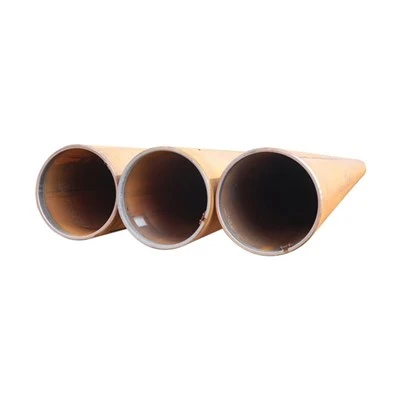
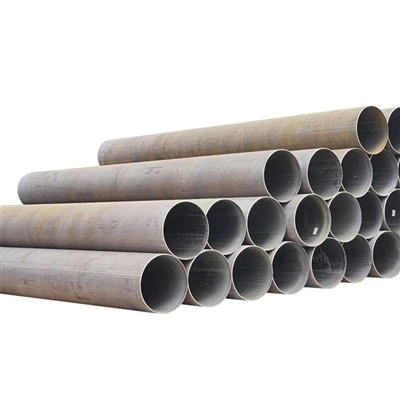
An LSAW steel pipe is manufactured using heavy, single steel plates as raw materials. The plate undergoes advanced cold-forming processes-such as the JCOE (J-ing, C-ing, O-ing, and E-ing) or UOE techniques-and is subsequently joined via double-sided submerged arc welding (DSAW). A defining characteristic of LSAW is its straight longitudinal weld seam and its post-weld full cold expansion, which relieves internal stress and guarantees perfect geometric roundness.
Electric Resistance Welded (ERW Steel Pipe)
An ERW Steel pipe is produced by cold-forming continuous hot-rolled steel coils into a cylindrical shape. Unlike submerged arc welding, the longitudinal seam of an
ERW Steel pipe is joined using high-frequency electrical current ($HFW$). This process creates a solid-state forge weld without adding any filler metals. The resulting seam is completely integrated, uniform, and post-weld heat-treated (PWHT) to match the microstructure of the parent metal plate.
Spiral Submerged Arc Welded (SSAW) Pipe
SSAW pipes are manufactured by rolling low-carbon structural steel strip or low-alloy structural steel strip into a pipe blank at a certain spiral angle (forming angle), and then welding the pipe seam. The welding method is also submerged arc welding, but the seam runs spirally around the circumference of the tube body.
2. Technical Comparison: Why LSAW and ERW Outperform SSAW in Critical Applications
When configuring high-pressure energy pipelines or heavy structural frameworks, LSAW steel pipe and
ERW Steel pipe offer distinct engineering advantages over spiral welded pipes.
Structural & Engineering Metrics
* Seam Length: LSAW / ERW (Short, Straight) vs. SSAW (Long, Spiral)
* Wall Gages: LSAW (Ultra-Thick, up to 50mm+) vs. ERW/SSAW (Thin-Medium)
* Precision: ERW / LSAW (Excellent OOR/WT) vs. SSAW (Moderate)
* Stress Risk: LSAW (Lowest via Expansion) vs. SSAW (Higher Residual)
Weld Seam Length and Stress Distribution
The weld seam of a straight longitudinal pipe (LSAW steel pipe and
ERW Steel pipe) is significantly shorter than that of a spiral pipe. A shorter weld seam naturally reduces the probability of welding defects, inclusions, or micro-cracks. Furthermore, spiral pipes carry complex multi-directional residual stresses along their spiral seams, making them less favorable for highly volatile, high-pressure environments.
Dimensional Accuracy and Geometric Tolerance
Modern ERW Steel pipe lines deliver exceptional concentricity, uniform wall thickness, and precise outer diameter (OD) tolerances due to continuous cold-rolling. Similarly, the mechanical cold expansion phase in
LSAW steel pipe production ensures extremely low out-of-roundness (OOR). This precision greatly facilitates faster, safer field alignment and welding compared to SSAW alternatives.
Wall Thickness and Large Diameter Capabilities
While ERW Steel pipe is exceptionally cost-effective for small-to-medium diameters and standard wall gauges,
LSAW steel pipe takes over for extreme heavy-duty needs. LSAW technology can effortlessly handle outside diameters from 16 to 60 inches and wall thicknesses exceeding 50 mm-capabilities that continuous coil-based pipes (ERW and SSAW) simply cannot reach.


3. Strict Compliance with Industry-Standard Specifications
To guarantee zero-failure performance in critical oil, gas, water, and structural applications, our LSAW steel pipe and
ERW Steel pipe products are manufactured in strict accordance with prominent global standards:
API 5L (American Petroleum Institute)
The gold standard for oil and gas line pipe transportation. Both LSAW and ERW pipes are fully certified under API 5L PSL1 and the highly stringent API 5L PSL2 protocols, spanning high-strength steel grades such as Grade B, X42, X52, X60, X65, and X70.
ASTM International Standards
ASTM A53: Standard specification for black and hot-dipped, zinc-coated, welded and seamless steel pipes for fluid transfer and mechanical processing.
ASTM A252: Governing structural steel pipe pilings, heavily utilized in deep foundation civil engineering.
ASTM A671 / ASTM A672: Specifying electric-fusion-welded steel pipe for atmospheric, lower, and moderate-temperature high-pressure service.
European and International Standards
EN 10219 / EN 10210: Governing cold-formed and hot-finished welded structural hollow sections of non-alloy and fine grain steels.
ISO 3183: Harmonizing international petroleum and natural gas pipeline transport system requirements.
4. Key Target Applications: LSAW vs. ERW
Because of their varying size ranges and structural strengths, LSAW steel pipe and
ERW Steel pipe serve complementary roles across different industrial sectors:
| Pipe Classification | Typical Size Boundaries | Primary Global Applications & Fields |
| ERW Steel Pipe | • OD: 1/2" to 26"
• WT: Up to 20mm | • Onshore oil & gas gathering line flowlines.
• Low-to-medium pressure urban natural gas distribution.
• Municipal water networks & district heating lines.
• Automotive chassis frameworks & scaffolding structures. |
| LSAW Steel Pipe | • OD: 16" to 60"
• WT: Up to 50mm+ | • High-pressure long-distance cross-country trunklines.
• Deep-water subsea offshore pipeline networks & risers.
• Heavy load-bearing structural bridge columns & building piles.
• Complex processing manifolds & skid-mounted stations. |
5. Huayang Steel Pipe: Your Premium LSAW and ERW Manufacturing Partner
When safety and project longevity are on the line, selecting a tier-one manufacturer is essential. Hebei Huayang Steel Pipe Co., Ltd. is a globally trusted manufacturer specializing in large-scale, high-precision production of LSAW steel pipe and
State-of-the-Art Quality Assurance
Every pipe leaving our factory undergoes an exhaustive, multi-stage testing regime to ensure zero defects. Our facilities are equipped with continuous online Ultrasonic Testing (UT), automated X-ray weld seam inspection, full-length hydrostatic testing to verified pressure limits, and a full suite of laboratory mechanical tests (including flattening, bending, and Charpy V-notch impact analysis).
Advanced Anti-Corrosion Coating Options
To maximize the lifecycle of your pipeline assets in aggressive environments, Huayang provides turnkey internal and external coating services. Our automated coating lines specialize in applying single/dual-layer Fusion Bonded Epoxy (FBE), 3-Layer Polyethylene (3LPE), 3-Layer Polypropylene (3LPP), and specialized internal liquid epoxy linings.
6. Conclusion: Choosing the Right Pipe for Project Optimization
In conclusion, although SSAW pipes are suitable for low-pressure water supply and small-scale structural projects, LSAW steel pipes and ERW steel pipes have taken the lead in applications in high-risk infrastructure fields. ERW steel pipes have the dual advantages of dimensional accuracy and economic value in medium and small-diameter steel pipes, while LSAW steel pipes possess excellent pressure-bearing capacity, thick-wall strength, and crack resistance, providing excellent guarantees for major energy pipeline projects and high-strength pile foundations and steel structure projects.
Collaborating with industry-leading enterprises not only enhances project efficiency but also reduces risks. The entire process is traceable. Please contact the engineering sales team of Hebei Huayang Steel Pipe Co., Ltd. immediately to discuss your technical specifications, obtain customized quotations, or learn about our rich manufacturing capabilities.