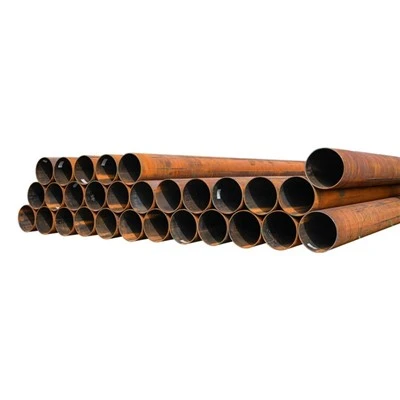
LSAW carbon steel pipe plays a decisive role in long-distance pipeline systems, cross-country gas transmission lines, offshore export pipelines, and major municipal infrastructure projects. While its manufacturing route based on plate forming and submerged arc welding is widely recognized, what ultimately differentiates reliable LSAW carbon steel pipe from standard welded pipe is the depth of quality control and performance verification embedded in the production cycle. From raw plate inspection to final hydrostatic testing, every stage directly affects structural reliability, weld integrity, and long-term service safety.
In high-pressure carbon steel pipe applications, especially for oil and gas transportation, owners and EPC contractors evaluate not only strength parameters but also fracture behavior, weld consistency, dimensional tolerance, and coating compatibility. Therefore, understanding how LSAW carbon steel pipe is tested and verified provides insight into why it remains a preferred solution in critical pipeline projects.
Raw Material Control and Plate Qualification
Steel Plate Chemistry and Mechanical Consistency
The quality of LSAW carbon steel pipe begins with steel plate selection. Unlike ERW or HFW pipe that relies on hot rolled coil, LSAW production uses heavy plate, typically manufactured through controlled rolling or thermo-mechanical controlled processing. Chemical composition must be carefully balanced to achieve required yield strength while maintaining low carbon equivalent values to improve weldability.
Excessive carbon or alloying elements may increase hardness in the heat affected zone, which can reduce fracture toughness. Therefore, plate qualification includes chemical analysis, tensile testing, impact testing, and sometimes drop weight tear testing depending on project specification. For transmission pipelines operating in low temperature environments, impact performance at sub-zero temperatures becomes particularly important.
The following table outlines typical chemical composition control ranges for common API grades used in LSAW carbon steel pipe.
| Grade | C Max % | Mn % | P Max % | S Max % | Typical Application |
|---|---|---|---|---|---|
| API 5L X52 | 0.22 | 1.40 | 0.030 | 0.030 | Oil gathering lines |
| API 5L X60 | 0.20 | 1.60 | 0.030 | 0.030 | Gas transmission |
| API 5L X65 | 0.18 | 1.70 | 0.030 | 0.030 | High-pressure trunk line |
| API 5L X70 | 0.17 | 1.80 | 0.030 | 0.030 | Long-distance pipeline |
These values may vary depending on mill practice and specification requirements, but tight chemical control is essential for ensuring weld quality and crack resistance.
Plate Ultrasonic Testing Before Forming
Before forming, steel plates are typically subjected to ultrasonic testing to detect lamination defects or internal discontinuities. Because LSAW carbon steel pipe is often used in high consequence areas, internal plate defects cannot be tolerated. Pre-forming inspection ensures that only qualified material enters the forming and welding stage, reducing the risk of downstream rejection.
Welding Process Control and Seam Integrity
Submerged Arc Welding Parameters
The longitudinal weld seam is the structural backbone of LSAW carbon steel pipe. Welding is usually performed in two passes, internal and external, using multi-wire submerged arc welding. Heat input, travel speed, current, and voltage must be carefully controlled to achieve full penetration without excessive grain growth.
Improper heat input may cause softening or hardening in the heat affected zone. To avoid this, welding procedure qualification records are developed and validated before mass production begins. Welding consumables are selected to match base metal strength and toughness requirements.


Non-Destructive Examination and Hydrostatic Testing
After welding, each LSAW carbon steel pipe undergoes comprehensive non-destructive examination. Ultrasonic testing is commonly applied to verify weld penetration and detect internal flaws. Radiographic inspection may be performed according to project requirements. In addition, magnetic particle testing can identify surface cracks along the weld seam.
Hydrostatic testing is conducted to confirm pressure resistance. The pipe is filled with water and pressurized to a level exceeding its design operating pressure. Any leakage or deformation leads to rejection. This process provides assurance that the pipe can withstand service conditions without failure.
The following table summarizes common inspection methods used for LSAW carbon steel pipe.
| Inspection Method | Inspection Area | Purpose |
|---|---|---|
| Ultrasonic Testing | Weld seam and plate body | Detect internal flaws |
| Radiographic Testing | Weld seam | Verify weld penetration |
| Magnetic Particle Testing | Surface and weld zone | Identify surface cracks |
| Hydrostatic Test | Entire pipe | Confirm pressure resistance |
| Dimensional Inspection | OD, WT, length | Verify tolerance compliance |
Comprehensive testing ensures that LSAW carbon steel pipe meets both mechanical and geometric requirements before delivery.
Fracture Toughness and Crack Propagation Resistance
Impact Testing and DWTT Performance
In high-pressure gas pipelines, fracture behavior is a critical design consideration. LSAW carbon steel pipe used in such systems must demonstrate adequate impact toughness to prevent brittle fracture. Charpy V-notch impact testing measures absorbed energy at specified temperatures, while drop weight tear testing evaluates crack propagation resistance.
High toughness is especially important in cold regions or high strain environments. Modern plate production techniques allow LSAW carbon steel pipe to achieve excellent toughness without sacrificing strength. This balance is essential for safe long-distance transmission systems.
Weld Seam Toughness Matching
Another important consideration is matching weld seam toughness to base metal properties. If weld metal toughness is significantly lower than base material, crack initiation may occur at the seam. Therefore, welding consumables and parameters are selected to ensure mechanical compatibility.
Coating Compatibility and Long-Term Durability
LSAW carbon steel pipe is commonly used in buried and offshore environments where corrosion protection is mandatory. External coatings such as three-layer polyethylene and fusion bonded epoxy are applied after surface preparation. Internal linings may also be used in water or chemical transmission pipelines.
Surface cleanliness, anchor profile, and dimensional stability influence coating adhesion. Because LSAW pipes have thick walls and stable geometry, they provide an excellent substrate for uniform coating application. Proper coating selection combined with cathodic protection extends service life significantly.
Conclusion
From raw plate qualification to final hydrostatic testing, the reliability of LSAW carbon steel pipe is built upon strict quality control and comprehensive performance verification. Chemical composition control ensures weldability and toughness. Advanced submerged arc welding guarantees seam integrity. Non-destructive examination and pressure testing confirm structural safety. Impact and fracture testing protect against brittle failure in demanding environments.
For pipeline owners, EPC contractors, and engineers, selecting LSAW carbon steel pipe means choosing a product whose performance is validated at every stage of manufacturing. In critical oil, gas, water, and structural applications, such verification is not optional but fundamental. As carbon steel pipe continues to serve as the backbone of global infrastructure, LSAW technology remains one of the most dependable solutions for projects requiring strength, safety, and long-term operational stability.