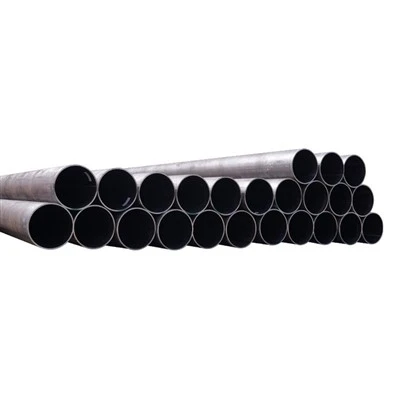
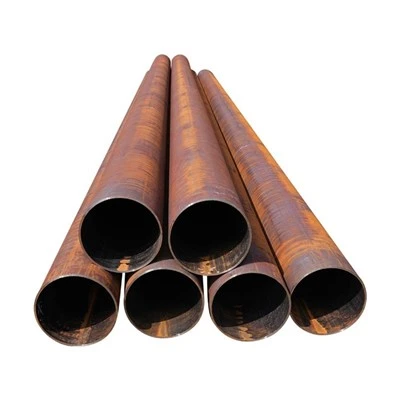
Carbon steel pipes used in industrial pipelines and structural systems must meet strict mechanical performance requirements. Among the most widely used types are Electric Resistance Welded pipes, Longitudinal Submerged Arc Welded pipes, and Spiral Submerged Arc Welded pipes. Each manufacturing process influences the final mechanical properties of the pipe, including yield strength, tensile strength, impact toughness, and weld seam reliability.
Understanding the mechanical performance characteristics of these pipes helps engineers determine which product is most suitable for specific applications such as oil and gas pipelines, structural construction, water transmission systems, and pressure-bearing installations. Although ERW pipes are typically used in small to medium diameter pipelines, their mechanical properties can be comparable to other welded pipe types when produced under modern manufacturing and quality control standards.
Mechanical Properties of ERW Carbon Steel Pipes
Yield Strength and Tensile Strength
The mechanical performance of ERW carbon steel pipes is largely determined by the chemical composition of the steel strip and the heat treatment conditions applied during manufacturing. Common material grades include API pipeline steels and structural carbon steels that provide balanced strength and ductility.
Yield strength represents the stress level at which permanent deformation begins, while tensile strength refers to the maximum stress a material can withstand before failure. For example, pipeline materials such as API 5L Grade B and X52 are widely used in ERW pipe production because they provide adequate strength for fluid transmission pipelines while maintaining good weldability.
During production, the steel strip is gradually formed into a cylindrical shape before high-frequency welding creates the longitudinal seam. Because the welding process does not use filler metal and produces a relatively narrow heat-affected zone, the mechanical properties of the weld seam can closely match those of the base metal when proper control measures are applied.
Typical mechanical property ranges for commonly used ERW pipe materials are summarized in the following table.
| Material Grade | Yield Strength MPa | Tensile Strength MPa | Typical Applications |
|---|---|---|---|
| ASTM A53 Gr.B | ≥240 | ≥415 | Structural and fluid pipelines |
| API 5L Gr.B | ≥245 | ≥415 | Oil and gas transportation |
| API 5L X52 | ≥360 | ≥460 | Medium pressure pipelines |
| API 5L X65 | ≥450 | ≥535 | High strength transmission pipelines |
These strength characteristics allow ERW pipes to perform reliably in many industrial systems where moderate pressure and mechanical loads are present.
Impact Toughness and Ductility
Impact toughness describes the ability of a material to absorb energy during sudden loading conditions, particularly at low temperatures. Carbon steel pipeline materials are often required to pass Charpy V-notch impact tests to verify their resistance to brittle fracture.
In ERW pipes, impact performance depends on the base steel quality and the control of the welding heat input. High-frequency welding produces a narrow heat-affected zone that can maintain favorable grain structure if cooling conditions are properly managed. Many ERW pipes used in pipeline construction therefore meet standard impact requirements specified in international standards such as ASTM A53 and EN pipeline standards.
In addition to impact performance, ductility measured through elongation tests ensures that the pipe can withstand bending and deformation during installation without cracking. Modern ERW pipes typically achieve elongation values between 20 percent and 30 percent depending on the material grade.


Weld Seam Quality and Performance Control
High Frequency Weld Integrity
The weld seam is one of the most critical factors affecting the performance of ERW pipes. In high-frequency welding, electrical current concentrates along the edges of the formed steel strip, generating heat that allows the edges to be forged together under pressure.
Because this process occurs without filler metal, the weld metal consists mainly of the base material itself. This creates a homogeneous joint structure when welding parameters such as temperature, pressure, and alignment are carefully controlled.
Modern ERW production lines include several inspection systems that ensure weld seam integrity. These systems often include online ultrasonic testing, eddy current inspection, and hydrostatic pressure testing. Such quality control measures verify that the weld seam meets mechanical strength requirements and does not contain critical defects.
Heat-Affected Zone Characteristics
The heat-affected zone, commonly called the HAZ, refers to the area of base metal that experiences thermal changes during welding. In ERW pipes the HAZ is typically narrow because the heating cycle is short and localized.
A narrow HAZ reduces the risk of excessive grain growth or mechanical property degradation. As a result, the mechanical strength and toughness of the weld seam area remain close to those of the surrounding base metal.
Performance Comparison with LSAW and SSAW Pipes
Strength Characteristics Across Welding Methods
While ERW pipes provide reliable mechanical properties for many applications, larger diameter pipelines often use pipes produced by submerged arc welding processes. Two common types are LSAW pipe and SSAW pipe.
LSAW pipes are manufactured from steel plate and welded using submerged arc welding along a straight longitudinal seam. Because thick plate can be used, LSAW pipes are capable of achieving very high strength and thick wall structures suitable for long-distance high-pressure pipelines.
SSAW pipes are produced from steel coil formed into a spiral shape before submerged arc welding. The spiral seam distributes stress along a longer weld path, which can provide good structural strength in large diameter pipelines, especially for water transmission and structural applications.
Mechanical Performance Comparison
Although all three pipe types can meet international pipeline standards, their mechanical performance characteristics vary due to differences in forming methods and weld seam geometry. The following table summarizes typical performance characteristics.
| Pipe Type | Weld Seam Orientation | Strength Capability | Typical Application |
|---|---|---|---|
| ERW | Straight longitudinal | Medium to high strength | Medium diameter pipelines |
| LSAW | Straight longitudinal | High strength, thick wall | Long distance oil and gas pipelines |
| SSAW | Spiral weld seam | Good structural strength | Large diameter water pipelines |
ERW pipes generally provide excellent dimensional accuracy and consistent mechanical properties for small and medium diameter pipelines. LSAW pipes offer superior thickness capacity and high strength performance, while SSAW pipes are well suited for very large diameter applications where cost efficiency is important.
Engineering Selection Considerations
The selection of pipe type for a project depends on several engineering factors including pipeline diameter, operating pressure, mechanical loads, and installation environment. For pipelines with moderate pressure and diameters below approximately 660 millimeters, ERW pipes often represent the most economical and technically appropriate solution.
For long distance energy pipelines requiring very thick walls and high strength materials, LSAW pipes may provide greater structural reliability. SSAW pipes are commonly used in large water transmission systems or infrastructure projects where extremely large diameters are required.
Conclusion
Mechanical properties such as yield strength, tensile strength, impact toughness, and weld seam integrity are essential factors in evaluating carbon steel pipeline performance. ERW pipes provide reliable mechanical characteristics due to controlled high-frequency welding processes and high-quality steel strip materials. Their narrow heat-affected zone and consistent weld seam structure allow them to achieve strength levels suitable for a wide range of industrial applications.
When compared with LSAW and SSAW pipes, ERW pipes occupy an important position in the medium diameter pipeline market, offering an effective balance between mechanical performance, dimensional accuracy, and manufacturing efficiency. Understanding these performance differences enables engineers to select the most appropriate pipe type for specific operational conditions and engineering requirements.