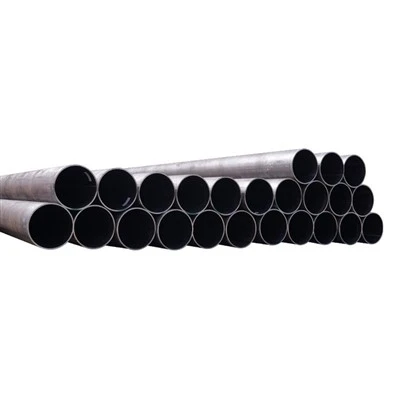
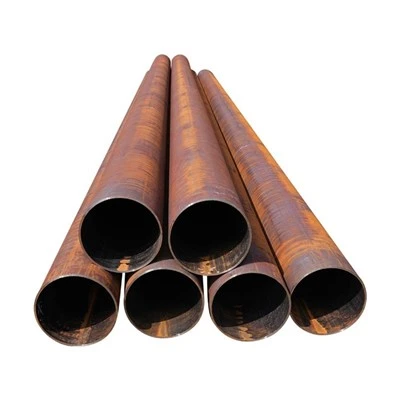
Electric Resistance Welded carbon steel pipes are widely used in structural systems, oil and gas transportation, water pipelines, and mechanical engineering. Unlike submerged arc welded pipes that rely on filler metal and flux protection, ERW pipes are produced through high-frequency electrical resistance welding, a process characterized by speed, precision, and controlled heat input. The manufacturing route directly influences weld integrity, dimensional accuracy, and mechanical performance. Understanding the core production stages and how they differ from LSAW and SSAW welding methods is essential for evaluating pipe quality and application suitability.
Raw Material Preparation and Forming Method
Steel Coil Selection and Preparation
ERW pipes are manufactured from hot-rolled steel coils. The chemical composition and mechanical properties of the coil are controlled according to the required pipe grade. Before forming, the coil edges are trimmed to ensure uniform width and smooth surfaces, which are critical for weld seam quality.
The strip is then uncoiled and fed continuously into a forming mill. Unlike plate-based pipe manufacturing, ERW production is highly automated and continuous, allowing high production efficiency.
Cold Forming into Tubular Shape
The forming process consists of multiple roll stands that gradually bend the flat strip into a circular shape. The deformation occurs progressively, minimizing residual stress concentration. By the time the strip reaches the welding station, the edges are precisely aligned to create a narrow V-shaped opening at the top.
The forming accuracy directly affects weld seam alignment and dimensional tolerance. Modern mills employ automatic edge positioning and diameter control systems to ensure consistent roundness and wall thickness distribution.
The following table outlines the main stages in ERW manufacturing.
| Production Stage | Process Description | Technical Objective | Quality Impact |
|---|---|---|---|
| Coil Preparation | Edge trimming and leveling | Uniform strip geometry | Stable weld seam |
| Progressive Forming | Multi-roll cold bending | Cylindrical shaping | Dimensional accuracy |
| High-Frequency Welding | Electrical resistance forging | Seam bonding | Structural integrity |
| Sizing & Straightening | Diameter calibration | Final dimension control | Tolerance compliance |
| Inspection & Testing | NDT and hydrostatic test | Defect detection | Service reliability |
This structured sequence ensures efficiency and repeatable quality control.


High-Frequency Electrical Resistance Welding Principle
Welding Mechanism
The defining feature of ERW production is high-frequency electrical resistance welding. High-frequency current, typically in the range of 100–500 kHz, is introduced to the aligned strip edges. The electrical current flows along the surface of the metal due to the skin effect and concentrates at the edges because of the proximity effect.
As resistance at the contact point generates intense localized heat, the edges reach plastic temperature within milliseconds. Mechanical pressure is then applied by squeeze rolls, forging the heated edges together without the addition of filler metal. The excess molten material is expelled as flash and subsequently removed.
This solid-state forging mechanism creates a weld with metallurgical continuity similar to the parent material when properly controlled.
Heat Input and Efficiency
Compared to arc welding methods, high-frequency resistance welding introduces lower overall heat input. The narrow heat-affected zone and short heating time reduce grain coarsening and residual stress accumulation. This contributes to consistent mechanical properties across the weld seam.
Control of the Heat-Affected Zone (HAZ)
Importance of HAZ Management
The heat-affected zone is the region adjacent to the weld seam where microstructure changes due to thermal exposure. In ERW pipes, HAZ control is critical because excessive heat may cause grain growth, hardness variation, or reduced toughness.
Because ERW welding occurs rapidly and without filler material, the HAZ is generally narrower than in submerged arc welding processes. However, improper parameter control can lead to incomplete fusion or excessive hardening.
Process Parameters Influencing HAZ
Key variables include welding current frequency, power input, squeeze pressure, and line speed. Higher frequency improves edge heating concentration and reduces heat penetration depth. Accurate synchronization of current and mechanical pressure ensures uniform bonding.
Post-weld heat treatment may be applied in certain grades to normalize microstructure and relieve residual stress, especially for higher-strength pipeline applications.
Comparison with LSAW and SSAW Welding Methods
Welding Technique Differences
LSAW and SSAW pipes utilize submerged arc welding, a fusion welding process that employs filler metal and granular flux. The arc is submerged under flux, providing shielding and deep penetration. This process typically involves multiple weld passes, particularly for thick-wall pipes.
In contrast, ERW relies on resistance heating and forging pressure without filler metal. The weld is created through solid-phase bonding rather than arc melting.
Structural and Operational Implications
Because LSAW uses thick steel plates and deep-penetration welding, it is suitable for heavy wall thickness and high-pressure pipelines. SSAW, which also uses submerged arc welding but with a spiral seam, allows large-diameter production from steel coil. However, the spiral seam increases total weld length, requiring comprehensive inspection.
ERW pipes generally offer superior dimensional accuracy and faster production speed, making them cost-effective for small and medium diameters. However, wall thickness capability is typically lower compared to LSAW.
The following table summarizes the core welding differences.
| Parameter | ERW | LSAW | SSAW |
|---|---|---|---|
| Welding Method | High-frequency resistance | Submerged arc (longitudinal) | Submerged arc (spiral) |
| Filler Metal | Not used | Used | Used |
| Heat Input | Low | Moderate to high | Moderate |
| HAZ Width | Narrow | Wider | Wider |
| Suitable Wall Thickness | Moderate | Thick | Moderate to thick |
| Production Speed | High | Moderate | Moderate |
This comparison highlights the distinct metallurgical and operational characteristics of each process.
Quality Assurance and Final Processing
After welding, ERW pipes pass through sizing rolls to achieve precise diameter and roundness. Online nondestructive testing, commonly ultrasonic inspection, verifies weld integrity. Hydrostatic pressure testing confirms leak resistance and structural performance.
Surface finishing, straightening, and cutting to required lengths complete the process. The final product combines dimensional consistency, reliable weld quality, and efficient manufacturing economics.
Conclusion
The manufacturing process of ERW carbon steel pipes is centered on high-frequency electrical resistance welding, which produces a forged longitudinal seam with minimal heat input and high production efficiency. Progressive cold forming ensures accurate geometry, while precise control of welding parameters maintains a narrow and stable heat-affected zone. Compared with LSAW and SSAW pipes that rely on submerged arc welding with filler metal, ERW offers faster production and excellent dimensional precision for small to medium diameters. Understanding these process differences enables engineers to select appropriate pipe types based on pressure requirements, diameter range, and economic considerations, ensuring safe and efficient application in diverse industrial environments.