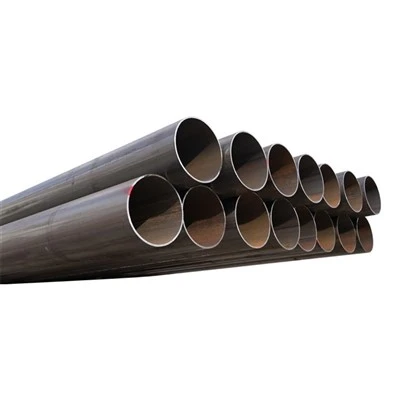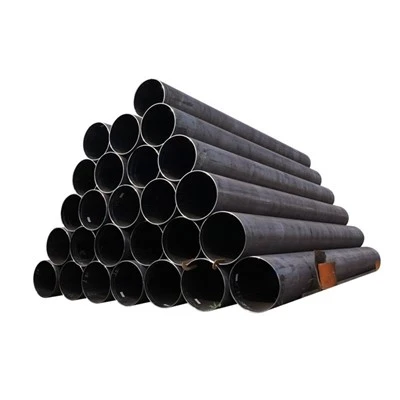
Black steel pipes and black iron pipes are two commonly discussed terms in the piping and construction industries. While they sound similar, they are not the same product. Understanding their differences in composition, manufacturing, strength, and applications helps ensure correct material selection for each project.


What Is a Seamless Black Steel Pipe?
A seamless black steel pipe is made from solid steel billets that are heated and then pierced through the center to create a hollow structure. The "black" appearance comes from the iron oxide coating formed during manufacturing. Unlike welded pipes, seamless black steel pipes do not have a seam or weld joint, which gives them greater uniformity and strength.
These pipes are often used in high-pressure, high-temperature, or critical applications where mechanical strength and reliability are essential - such as oil and gas transport, power generation, and industrial fluid lines.
Manufacturing Process of Seamless Black Steel Pipe
The seamless process involves several steps:
- Billet preparation: Steel billets are heated to a specific temperature.
- Piercing: A piercing mandrel creates the hollow tube.
- Elongation and sizing: The tube is elongated and rolled to reach the desired diameter and wall thickness.
- Heat treatment and finishing: The pipe undergoes annealing or normalization to achieve uniform grain structure.
Because it is seamless, the pipe has uniform pressure-bearing capacity and superior resistance to deformation under stress.
What Is a Black Iron Pipe?
Despite its name, black iron pipe is not actually made of pure iron. It is typically low-carbon steel pipe coated with a black oxide finish to resist corrosion. Black iron pipe is commonly used for low-pressure applications like gas lines, sprinkler systems, or general water distribution in non-corrosive environments.
It is usually welded rather than seamless, which makes it more cost-effective but less strong than seamless black steel pipe. The welded seam can be a weak point under pressure or high-temperature conditions.
Typical Features of Black Iron Pipe
- Manufactured using a welding process (ERW or furnace welded)
- More economical than seamless steel pipe
- Suitable for indoor plumbing and gas distribution
- Can be threaded easily for connection
Key Differences Between Seamless Black Steel Pipe and Black Iron Pipe
While both pipes are dark in appearance, their composition, manufacturing methods, and applications differ significantly.
| Comparison Item | Seamless Black Steel Pipe | Black Iron Pipe |
|---|---|---|
| Material Composition | Carbon steel (high strength) | Low-carbon steel |
| Manufacturing Method | Hot-rolled and pierced seamless process | Electric resistance welded (ERW) |
| Surface Finish | Black oxide from heat treatment | Black paint or lacquer coating |
| Seam Presence | No seam | Has a welded seam |
| Pressure Resistance | High, suitable for high-pressure pipelines | Low, suitable for low-pressure use |
| Applications | Oil & gas, boiler tubes, mechanical tubing | Gas lines, water, and fire sprinklers |
| Strength & Durability | Excellent strength and long service life | Lower strength, prone to corrosion |
| Cost | Higher due to seamless production | Lower and more economical |
| Common Standards | ASTM A106, API 5L | ASTM A53, low-pressure standards |
From this comparison, it is clear that seamless black steel pipes are designed for industrial-grade projects, while black iron pipes are typically found in domestic or low-pressure systems.
Applications in Different Industries
Seamless black steel pipes are essential in sectors that demand high performance and safety. For instance:
- Oil and Gas: Transporting crude oil, gas, and petroleum products under high pressure.
- Power Plants: Carrying superheated steam or condensate.
- Boiler and Heat Exchangers: Withstanding high temperature and corrosion.
Black iron pipes, on the other hand, are more suitable for:
- Residential Gas Lines: Safe and cost-effective distribution of natural gas.
- Fire Sprinkler Systems: Non-corrosive environments with low flow pressure.
- Water Supply Systems: Limited to non-drinking and indoor use only.
Performance Comparison: Strength and Durability
Seamless black steel pipes are known for their mechanical integrity. The absence of a seam means no weak points, making them ideal for high-stress operations. Their yield strength and tensile strength typically exceed that of black iron pipes.
| Property | Seamless Black Steel Pipe | Black Iron Pipe |
|---|---|---|
| Tensile Strength (MPa) | 415–550 | 330–370 |
| Yield Strength (MPa) | 240–345 | 200–240 |
| Elongation (%) | 20–25 | 25–30 |
| Maximum Working Pressure | Up to 20 MPa | Below 3 MPa |
| Temperature Range | -40°C to 450°C | Up to 150°C |
Although black iron pipes show better ductility, their limited pressure resistance restricts their use in heavy-duty applications.
Corrosion Resistance and Maintenance
Both pipe types have a dark protective surface layer. However, seamless black steel pipes generally perform better in mildly corrosive environments, especially when treated with anti-corrosion coatings or used with 3PE/epoxy linings.
Black iron pipes are not recommended for transporting water or corrosive fluids over time, as oxidation can lead to internal rusting and leakage. Periodic inspection and coating maintenance are necessary to prevent deterioration.
Cost Consideration and Long-Term Value
At first glance, black iron pipe seems cheaper due to its lower manufacturing cost. However, for industries prioritizing safety and performance, seamless black steel pipe offers greater long-term value by reducing maintenance, repair, and replacement frequency.
In high-pressure environments, using black iron pipe could lead to premature failure - resulting in far higher repair costs and downtime. Hence, the total cost of ownership often favors seamless steel solutions.
Huayang Steel Pipe's Role in Seamless Pipe Manufacturing
Huayang Steel Pipe, a leading Chinese manufacturer based in Mengcun, Hebei, specializes in producing ERW, SSAW, and seamless steel pipes. The company provides:
- Outer diameter range: Φ73–Φ1422.4 mm
- Wall thickness: 2.5–50 mm
- Standards: ASTM A106, API 5L, EN10219, and more
Huayang ensures consistent quality through:
- Advanced piercing and forming equipment
- On-site mechanical and chemical testing
- Non-destructive testing (NDT) for internal defects
- Customized coating and export packaging
Through these processes, Huayang delivers pipes suitable for global energy, construction, and infrastructure projects.
Conclusion: Choosing the Right Pipe for Your Application
While both seamless black steel and black iron pipes have their uses, the right choice depends on operating pressure, temperature, and environmental conditions. For demanding industrial operations, seamless black steel pipe remains the preferred option due to its reliability, strength, and lifespan.
Huayang Steel Pipe provides full-grade solutions compliant with ASTM and API standards, ensuring top-quality materials for global partners.