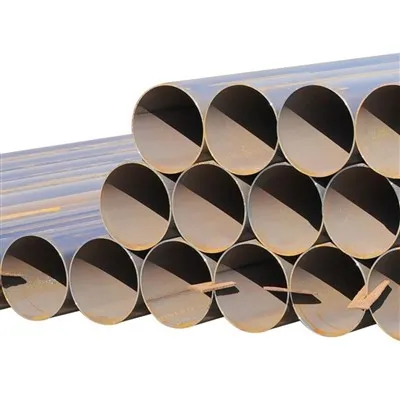
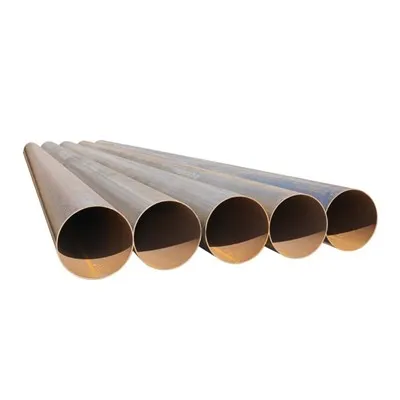
In the realm of heavy-duty infrastructure-ranging from massive bridge foundations and offshore platforms to critical energy pipelines and structural components for industrial facilities-the demand for materials with exceptional strength, durability, and structural integrity is paramount. Among the various steel pipe manufacturing methods, Longitudinally Submerged Arc Welded (LSAW) steel pipes stand out as the preferred choice for large-diameter, thick-walled applications where uncompromising structural performance is non-negotiable. The inherent advantages of the Submerged Arc Welding (SAW) process, combined with meticulous forming techniques, make LSAW pipes essential for ensuring the long-term stability and safety of these vital structures. This article explores the structural integrity of LSAW steel pipes and elucidates why large-diameter submerged arc welding is essential for heavy-duty infrastructure. Hebei Huayang Steel Pipe Co., Ltd., a leading manufacturer of LSAW steel pipes, is at the forefront of delivering these high-integrity solutions.
The Foundation of Strength: The LSAW Manufacturing Process
LSAW pipes are manufactured from single steel plates, which are first cold-formed into a cylindrical shape and then welded longitudinally using the Submerged Arc Welding (SAW) process. This method is particularly suited for producing pipes with large diameters and heavy wall thicknesses, offering superior structural characteristics. The common forming methods include:
•JCOE (J-ing, C-ing, O-ing, Expanding): A multi-step process that precisely forms the plate into a pipe shape.
•UOE (U-ing, O-ing, Expanding): Similar to JCOE, but with a U-ing and O-ing press forming the plate.
•Roll Bending: For very large diameters, plates are progressively bent into shape.


The Critical Role of Submerged Arc Welding (SAW):
SAW is a highly efficient and robust welding process characterized by:
1.Deep Penetration: The arc is submerged under a blanket of granular flux, which protects the weld pool from atmospheric contamination and allows for very high heat input. This results in deep, consistent penetration, crucial for welding thick-walled pipes.
2.High Deposition Rates: SAW can achieve significantly higher deposition rates compared to other welding methods, making it ideal for producing long, high-quality welds efficiently.
3.Excellent Weld Metal Properties: The flux plays a vital role in refining the weld metal, contributing to excellent mechanical properties, including high strength and toughness, even at low temperatures.
4.Full Penetration and Fusion: The process ensures full penetration and fusion throughout the pipe wall thickness, eliminating internal defects and creating a homogeneous weld seam that is as strong as, or stronger than, the parent material.
Why LSAW Pipes Offer Superior Structural Integrity
The combination of large diameter, heavy wall thickness, and the advanced SAW process endows LSAW steel pipes with exceptional structural integrity, making them indispensable for heavy-duty applications:
1. High Load-Bearing Capacity
LSAW pipes are designed to withstand immense external and internal pressures, axial loads, and bending moments. Their large diameter and thick walls provide a high moment of inertia, making them highly resistant to buckling and deformation under extreme stresses. This is critical for applications like deepwater pipelines, structural piles, and bridge supports.
2. Excellent Toughness and Ductility
The controlled welding parameters and the metallurgical benefits of the SAW process result in weld metal and heat-affected zones (HAZ) with excellent toughness and ductility. This property is vital for resisting brittle fracture, especially in low-temperature environments or under dynamic loading conditions (e.g., seismic activity, wave action).
3. Uniform Mechanical Properties
Through precise control of the forming and welding processes, LSAW pipes exhibit highly uniform mechanical properties across the entire pipe body, including the weld seam. This consistency ensures predictable behavior under stress and simplifies structural design calculations.
4. Resistance to Fatigue and Fracture
The high quality of the SAW weld, characterized by full penetration and minimal defects, significantly enhances the pipe's resistance to fatigue crack initiation and propagation. This is crucial for structures subjected to cyclic loading over their operational lifespan.
5. Adaptability to Demanding Environments
LSAW pipes can be manufactured from a wide range of high-strength low-alloy (HSLA) steels, allowing for customization to specific environmental challenges, such as sour service (H2S environments), high-pressure applications, or extreme temperatures. The robust nature of LSAW makes it suitable for offshore platforms, subsea pipelines, and other critical marine structures.
Applications in Heavy-Duty Infrastructure
Hebei Huayang Steel Pipe Co., Ltd.'s LSAW steel pipes are integral to a multitude of heavy-duty infrastructure projects globally:
•Oil and Gas Transmission: Large-diameter, high-pressure pipelines for long-distance transport of crude oil, natural gas, and refined products.
•Offshore Structures: Piles for offshore platforms, risers, and subsea pipelines.
•Construction and Civil Engineering: Structural columns, bridge foundations, tunnel linings, and large-span building supports.
•Water Infrastructure: Large-scale water transmission mains and penstocks for hydroelectric power plants.
Huayang's Commitment to LSAW Structural Integrity
At Hebei Huayang Steel Pipe Co., Ltd., our LSAW manufacturing process is meticulously controlled to ensure the highest levels of structural integrity. We employ advanced forming technologies (JCOE/UOE), multi-wire SAW systems, and comprehensive quality control measures, including 100% ultrasonic testing of the weld seam and pipe body, X-ray inspection, hydrostatic testing, and mechanical property verification. Our LSAW pipes meet and exceed international standards such as API 5L, ASTM, and EN, providing unparalleled reliability for the most demanding infrastructure projects.
Key Factors Contributing to LSAW Structural Integrity
|
Factor |
Description |
Benefit for Heavy-Duty Infrastructure |
|
Large Diameter & Thick Wall |
Manufactured from single plates, allowing for robust dimensions. |
High load-bearing capacity, resistance to buckling and deformation. |
|
Submerged Arc Welding (SAW) |
Deep penetration, high deposition rates, excellent weld metal properties. |
Ensures full penetration, strong, homogeneous weld, superior toughness. |
|
Uniform Mechanical Properties |
Consistent strength and ductility across pipe body and weld. |
Predictable behavior under stress, reliable performance in critical applications. |
|
Resistance to Fatigue/Fracture |
High-quality weld minimizes defects, enhances crack resistance. |
Long operational lifespan, safety in dynamic loading environments. |
|
Material Adaptability |
Can be produced from various HSLA steels. |
Customization for specific environmental challenges (e.g., sour service, low temp). |
In conclusion, the structural integrity of LSAW steel pipes, forged through the precision of large-diameter forming and the robustness of Submerged Arc Welding, makes them an indispensable component for heavy-duty infrastructure worldwide. Their ability to withstand extreme loads, resist fatigue, and maintain performance in challenging environments ensures the safety and longevity of critical projects. Hebei Huayang Steel Pipe Co., Ltd. is dedicated to providing LSAW steel pipes that embody this superior integrity, empowering the construction of resilient and enduring infrastructure for the future.