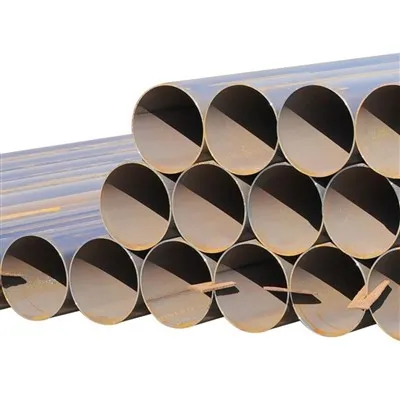
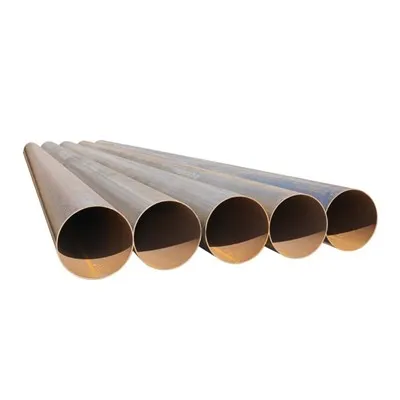
Longitudinally Submerged Arc Welded (LSAW) steel pipes are the workhorses of large-diameter, high-pressure pipeline projects, critical for transporting oil, gas, and water across vast distances and challenging terrains. Their superior strength and structural integrity are largely attributed to the robust Submerged Arc Welding (SAW) process. However, to truly optimize performance and ensure these pipes meet the most stringent industry standards, two crucial stages in the manufacturing process play an indispensable role: mechanical expansion and rigorous testing. This article delves into the significance of these steps in LSAW steel pipe manufacturing, explaining how they enhance dimensional accuracy, improve mechanical properties, and guarantee the unwavering reliability demanded by modern infrastructure. Hebei Huayang Steel Pipe Co., Ltd., a leader in LSAW pipe production, highlights its commitment to these advanced techniques.
The Power of Mechanical Expansion: Cold Working for Enhanced Properties
After the steel plate is formed into a cylindrical shape and welded longitudinally, the pipe undergoes a mechanical expansion process. This is a cold-working operation where the pipe is expanded from the inside out to its final precise diameter. The most common methods are:
•Mechanical Expander: A segmented die is pushed through the pipe, expanding it uniformly.
•Hydrostatic Expander: The pipe is filled with water and pressurized, causing it to expand against an external die.


How Expansion Optimizes LSAW Pipe Performance:
1.Improved Dimensional Accuracy: Expansion precisely controls the pipe's outside diameter and roundness, reducing ovality and ensuring tight tolerances. This is crucial for seamless fit-up during field welding and for maintaining consistent flow characteristics.
2.Enhanced Mechanical Properties: The cold working induced by expansion significantly improves the pipe's yield strength and tensile strength. This phenomenon, known as strain hardening, allows for the use of thinner wall thicknesses while maintaining the required pressure containment capabilities, leading to material savings and reduced transportation costs.
3.Reduced Residual Stresses: Welding introduces residual stresses into the pipe. Expansion helps to redistribute and reduce these stresses, leading to a more stable and structurally sound pipe that is less prone to distortion or stress corrosion cracking.
4.Proof Testing: During hydrostatic expansion, the pipe is subjected to internal pressure that often exceeds its specified minimum yield strength. This acts as a proof test, revealing any potential weaknesses or defects that might have gone undetected, thereby enhancing the overall reliability.
5.Straightness Improvement: The expansion process also contributes to improving the straightness of the pipe, which is vital for efficient transportation and installation.
Rigorous Testing: The Uncompromising Guarantee of Quality
Even with advanced manufacturing and expansion, comprehensive testing is the ultimate assurance of an LSAW pipe's integrity and performance. Hebei Huayang employs a multi-stage testing regimen that adheres to international standards such as API 5L, ASTM, and EN.
Key Testing Procedures in LSAW Manufacturing:
1.Non-Destructive Testing (NDT):
•Ultrasonic Testing (UT): 100% of the weld seam and often the entire pipe body are scanned using advanced ultrasonic equipment to detect internal and external flaws, such as cracks, laminations, and inclusions.
•Radiographic Testing (RT) / X-ray Inspection: Used to inspect the weld seam for internal defects, providing a visual record of weld quality.
•Magnetic Particle Inspection (MPI) / Dye Penetrant Inspection (DPI): Used to detect surface-breaking defects on the weld and pipe body.
2.Hydrostatic Testing: Every LSAW pipe undergoes a hydrostatic test, where it is filled with water and pressurized to a level significantly higher than its maximum allowable operating pressure. This test verifies the pipe's leak-tightness and its ability to withstand internal pressure without rupture or excessive deformation.
3.Mechanical Property Testing: Samples cut from the pipe (including weld and heat-affected zone) are subjected to:
•Tensile Tests: To determine yield strength, tensile strength, and elongation.
•Charpy Impact Tests: To assess the pipe's toughness and resistance to brittle fracture, especially critical for low-temperature applications.
•Bend Tests: To evaluate the ductility and soundness of the weld.
•Flattening Tests: To check the pipe's ductility and weld integrity.
4.Metallographic Examination: Microscopic analysis of weld cross-sections to evaluate grain structure, heat-affected zone characteristics, and overall weld quality.
5.Dimensional Inspection: Precise measurement of outside diameter, wall thickness, length, straightness, and ovality to ensure compliance with specified tolerances.
Huayang's Integrated Approach to LSAW Pipe Optimization
At Hebei Huayang Steel Pipe Co., Ltd., mechanical expansion and rigorous testing are integral parts of our LSAW pipe manufacturing philosophy. Our state-of-the-art facilities include advanced expansion equipment and a fully equipped in-house laboratory for comprehensive testing. This integrated approach ensures that every LSAW pipe we produce not only meets but often exceeds the most demanding project specifications for strength, dimensional accuracy, and reliability.
By meticulously controlling the expansion process and implementing a multi-layered testing regimen, we deliver LSAW steel pipes that offer optimized performance, reduced project risks, and extended service life for critical infrastructure worldwide.
Key Roles of Expansion and Testing in LSAW Pipe Performance
|
Process Stage |
Key Activities |
Impact on LSAW Pipe Performance |
|
Mechanical Expansion |
Cold working, precise diameter control, stress redistribution. |
Improves dimensional accuracy, enhances yield/tensile strength, reduces residual stresses, acts as proof test. |
|
Non-Destructive Testing (NDT) |
UT, RT, MPI/DPI of weld seam and pipe body. |
Detects internal and external flaws, ensures structural integrity without damaging the pipe. |
|
Hydrostatic Testing |
Internal pressure testing beyond operating pressure. |
Verifies leak-tightness, confirms ability to withstand specified pressure. |
|
Mechanical Property Testing |
Tensile, Charpy impact, bend, flattening tests. |
Confirms material strength, toughness, ductility, and weld soundness. |
|
Metallographic Examination |
Microscopic analysis of weld and HAZ. |
Assesses microstructure, ensures optimal weld quality and material properties. |
In conclusion, the optimization of performance in LSAW steel pipe manufacturing is a testament to the combined power of advanced processes like mechanical expansion and an uncompromising commitment to rigorous testing. These stages are not mere checkpoints but active contributors to enhancing the pipe's dimensional precision, mechanical strength, and overall reliability. Hebei Huayang Steel Pipe Co., Ltd. leverages these critical steps to deliver LSAW steel pipes that consistently meet the highest industry standards, providing the robust and dependable foundation required for the world's most challenging heavy-duty infrastructure projects.