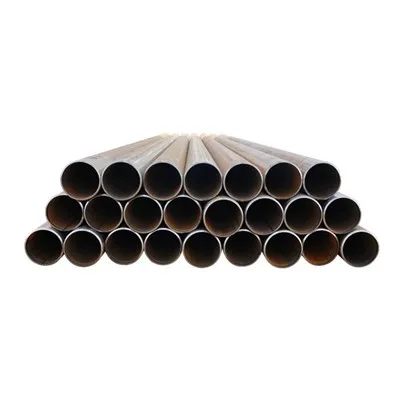
In modern steel pipe manufacturing, different welding processes are adopted to meet various engineering requirements, performance standards, and application environments. Among the commonly used welded pipe types, ERW, LSAW, and HSAW pipes represent three major production technologies. Each process produces pipes with unique characteristics, advantages, and suitable applications. As a professional manufacturer of welded steel pipes, Huayang Steel Pipe utilizes advanced forming and welding technologies to deliver high-quality products for domestic and international projects.
Below is a clear and structured explanation of the differences between ERW, LSAW, and HSAW pipes.
1. ERW / HFW Pipes
ERW stands for Electric Resistance Welding, also known as High Frequency Welding. This process uses the resistance generated by high-frequency current to heat the edges of a steel strip, which are then pressed together to form a welded joint. ERW pipes have longitudinal weld seams and are produced without the use of filler metal.
Key Characteristics of ERW Pipes
• Straight longitudinal weld seam
• Very small heat-affected zone due to high-frequency welding
• Smooth inner and outer weld appearance
• Typically used for small to medium diameter pipes
• High production speed and stable quality consistency
During production, coils are unrolled, flattened, formed into cylindrical shapes, and welded at high speed. The productivity of ERW pipes can reach around 12 meters per minute, making it an efficient process for mass production.
Because ERW pipes do not use filler material and have excellent dimensional tolerances, they are widely used in low to medium pressure pipelines, structural applications, water supply systems, and mechanical tubing.


2. LSAW Pipes
LSAW stands for Longitudinal Submerged Arc Welding. This method begins with cutting steel plates into specific widths, which are then formed into pipe shapes using various press-forming processes. Once formed, both sides of the seam are joined and welded longitudinally using submerged arc welding.
Key Characteristics of LSAW Pipes
• Straight and uniform longitudinal weld seam
• Welded using filler metal and submerged arc welding technology
• Small heat-affected zone, similar to ERW
• Suitable for large diameter, thick-wall, and high-strength pipelines
• Excellent mechanical properties and weld integrity
LSAW pipe production speed is typically around 4 meters per minute, slower than ERW due to more complex forming and welding steps. However, LSAW pipes offer superior weld penetration, stable mechanical performance, and strict dimensional control, making them suitable for applications requiring high reliability.
LSAW pipes are commonly used in long-distance oil and gas pipelines, onshore and offshore engineering, piling foundations, structural steel columns, and other critical applications.
3. HSAW Pipes
HSAW stands for Helical Submerged Arc Welding, also known as SSAW (Spiral Submerged Arc Welding). In this process, steel coils are spirally formed into cylindrical pipes, and the edges are welded using submerged arc welding.
Key Characteristics of HSAW Pipes
• Spiral welding seam along the body of the pipe
• Uses filler metal with double-sided submerged arc welding
• Larger heat-affected zone due to spiral welding
• Higher production flexibility with adjustable diameters
• Weld seam length is 1.5 to 2 times the pipe length
HSAW pipe production speed is typically around 2 meters per minute and is slower than ERW and LSAW. However, its ability to produce large-diameter pipes using narrow-width steel coil makes it cost-effective for certain applications.
HSAW pipes are commonly used for water pipelines, piling, structural support, and low-to-medium pressure transportation systems.
Comparison Summary
To better understand the differences among the three processes, below is a concise comparison:
Welding Technology
• ERW: Uses high-frequency resistance welding without filler metal
• LSAW: Uses submerged arc welding with filler metal along a longitudinal seam
• HSAW: Uses submerged arc welding along a spiral seam
Heat-Affected Zone
• Smallest: ERW
• Small: LSAW
• Larger: HSAW
Production Productivity
• ERW: Approximately 12 m/min
• LSAW: Approximately 4 m/min
• HSAW: Approximately 2 m/min
Weld Seam Length
• ERW and LSAW: Straight, same as pipe length
• HSAW: Spiral seam 1.5–2 times pipe length
Application Scope
• ERW: Medium diameter, low to medium pressure pipelines
• LSAW: Large diameter, thick-wall, high-pressure or long-distance pipelines
• HSAW: Large diameter, low to medium pressure, structural piles, water pipelines
Conclusion
ERW, LSAW, and HSAW steel pipes each serve distinct roles across various industries. ERW pipes provide excellent dimensional precision and high productivity. LSAW pipes ensure superior weld quality and are widely used in demanding pipeline systems. HSAW pipes offer cost advantages and flexibility in large-diameter production.
With advanced manufacturing technology and strict quality control, Huayang Steel Pipe delivers all three types of welded pipes to meet the needs of domestic and global customers. Whether for oil and gas transportation, water supply systems, structural engineering, or offshore applications, selecting the appropriate welding method ensures safety, durability, and long-term performance.