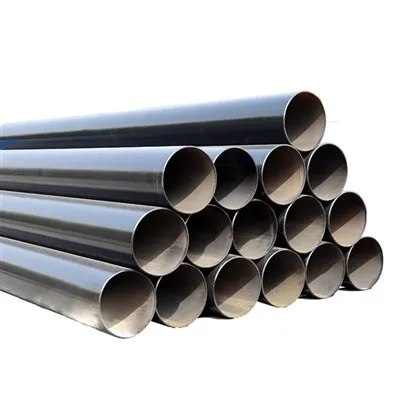
In modern infrastructure construction and industrial engineering, steel pipes serve as crucial connection and transmission carriers, playing an irreplaceable role. Among them, ERW (Electric Resistance Welded) steel pipes are widely used in various industries due to their mature manufacturing process, stable quality performance, and favorable cost-effectiveness. This article provides a systematic popular science interpretation of ERW steel pipes from aspects such as basic concepts, manufacturing characteristics, technical advantages, and typical applications.
I. What is ERW Steel Pipe?
ERW steel pipe is a type of welded steel pipe manufactured through the electric resistance welding process. Its production process uses hot-rolled steel strips as raw materials. The steel strip is gradually bent into a tubular shape through continuous forming rolls, and under the action of high-frequency current, the edges of the steel strip are rapidly heated and fused under extrusion force to form a continuous and dense weld.
This process does not require the addition of welding wire or flux, with stable and controllable welding and high forming efficiency, enabling ERW steel pipes to exhibit outstanding performance in dimensional consistency and surface quality.


II. Manufacturing Characteristics of ERW Steel Pipes
ERW steel pipes usually adopt a continuous production mode with a high degree of automation. The processes from uncoiling, forming, welding, sizing to cutting are closely connected. This manufacturing method ensures good consistency in the outer diameter, wall thickness, and straightness of the steel pipes.
At the same time, the weld undergoes online inspection and subsequent treatment during production, which helps improve the stability of welding quality and meet the requirements of conventional engineering for steel pipe quality.
III. Main Advantages of ERW Steel Pipes
1. Significant Comprehensive Cost Advantage
Due to high production efficiency and high raw material utilization rate, ERW steel pipes have good cost control capabilities in mass projects, making them particularly suitable for municipal pipe networks, construction projects, and conventional transmission systems.
2. Good Dimensional Accuracy and Appearance Quality
Continuous forming and sizing processes result in small outer diameter deviations and flat surfaces of ERW steel pipes. After weld treatment, the transition with the base metal is natural, facilitating subsequent installation and processing.
3. Stable Strength and Service Life
Under reasonable design and standardized usage conditions, ERW steel pipes can meet medium and low-pressure transmission requirements, with good structural strength and service life, suitable for long-term operation engineering projects.
4. Adaptable to Various Engineering Needs
ERW steel pipes cover a wide range of specifications, and appropriate steel grades and sizes can be selected according to different engineering requirements, offering high flexibility.
IV. Typical Application Fields of ERW Steel Pipes
Thanks to their balanced performance and strong applicability, ERW steel pipes are widely used in various industries, including but not limited to the following fields:
- In municipal engineering: Commonly used in urban water supply, drainage, and gas transmission systems;
- In the construction field: Widely applied to steel structural components, scaffolding, and support systems;
- In industrial manufacturing: Usable for mechanical structures, heat exchange equipment, and some pressure vessels;
- In the energy industry: Frequently used in medium and low-pressure oil, gas, and water transmission pipelines.
Although the requirements for steel pipes in these applications vary, ERW steel pipes can meet the needs of most conventional projects through their stable quality performance and mature manufacturing technology.
V. Rational Understanding of ERW Steel Pipes
Despite their various advantages, in high-pressure, large-diameter, or extreme service environments, engineering projects often choose other types of steel pipe products. Therefore, in the actual selection process, a comprehensive evaluation should be conducted considering factors such as engineering design pressure, service environment, pipe diameter and wall thickness, and budget.
Reasonable selection of ERW steel pipes can not only ensure project safety but also help achieve the overall economy and construction efficiency of the project.
Conclusion
As a mature and reliable welded steel pipe product, ERW steel pipes occupy an important position in modern engineering construction due to their high manufacturing efficiency, stable quality, and wide application range. Through scientific selection and standardized use, ERW steel pipes can continuously exert their value in fields such as water supply, municipal administration, construction, and industry, providing reliable support for engineering projects.