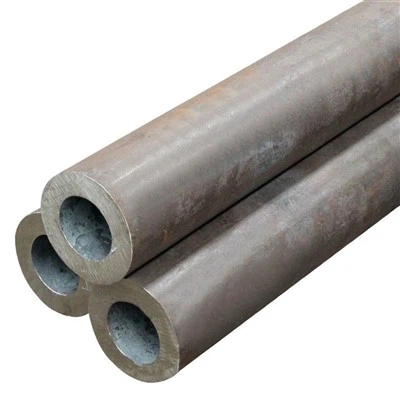
What is the Poisson's ratio of ASTM boiler pipes?
As a supplier of ASTM Boiler Pipes, I often encounter various technical inquiries from customers. One of the frequently asked questions is about the Poisson's ratio of these pipes. In this blog, I will delve into the concept of Poisson's ratio, its significance in ASTM boiler pipes, and how it impacts the performance and applications of these essential components.
Understanding Poisson's Ratio
Poisson's ratio is a fundamental mechanical property that describes the relationship between the lateral strain and the longitudinal strain of a material when it is subjected to an axial load. In simpler terms, when a material is stretched or compressed in one direction, it will also deform in the perpendicular directions. Poisson's ratio, denoted by the Greek letter ν (nu), is defined as the negative ratio of the transverse strain (εt) to the axial strain (εa):
ν = - εt / εa
For most materials, Poisson's ratio ranges between 0 and 0.5. A value of 0.5 indicates that the material is incompressible, meaning that its volume remains constant during deformation. On the other hand, a value of 0 indicates that the material does not experience any lateral deformation when subjected to an axial load.
Poisson's Ratio in ASTM Boiler Pipes
ASTM boiler pipes are used in a wide range of applications, including power generation, industrial heating, and steam production. These pipes are typically made from high-quality carbon steel or alloy steel and are designed to withstand high pressures and temperatures. The Poisson's ratio of ASTM boiler pipes plays a crucial role in determining their mechanical behavior and performance under various operating conditions.
One of the key factors that affect the Poisson's ratio of ASTM boiler pipes is the material composition. Different types of steel have different Poisson's ratios, which can vary depending on the alloying elements and the manufacturing process. For example, carbon steel typically has a Poisson's ratio of around 0.3, while some alloy steels may have a slightly higher or lower value.
Another important factor is the temperature. As the temperature of the boiler pipes increases, the Poisson's ratio may also change. This is because the thermal expansion and contraction of the material can affect its mechanical properties, including the lateral and axial strains. In general, the Poisson's ratio of ASTM boiler pipes tends to increase with increasing temperature, although the exact relationship can vary depending on the specific material and operating conditions.
Significance of Poisson's Ratio in Boiler Pipe Applications
The Poisson's ratio of ASTM boiler pipes has several important implications for their performance and applications. Here are some of the key areas where Poisson's ratio plays a significant role:
- Stress Analysis: When designing and analyzing boiler pipes, engineers need to consider the stress distribution within the pipes. Poisson's ratio affects the lateral and axial stresses in the pipes, which can impact their structural integrity and durability. By accurately predicting the Poisson's ratio of the pipes, engineers can ensure that the pipes are designed to withstand the expected loads and pressures.
- Thermal Expansion and Contraction: ASTM boiler pipes are subjected to significant temperature changes during operation. The Poisson's ratio affects the thermal expansion and contraction of the pipes, which can cause thermal stresses and strains. By understanding the Poisson's ratio of the pipes, engineers can design appropriate expansion joints and supports to accommodate the thermal movement and prevent damage to the pipes.
- Pipe Fittings and Connections: The Poisson's ratio of ASTM boiler pipes also affects the performance of pipe fittings and connections. When pipes are joined together, the lateral and axial strains in the pipes can cause stress concentrations at the joints. By selecting the appropriate pipe fittings and connections based on the Poisson's ratio of the pipes, engineers can ensure that the joints are strong and reliable.
Our Product Range
As a leading supplier of ASTM Boiler Pipes, we offer a wide range of high-quality products to meet the diverse needs of our customers. Our product portfolio includes X60 OCTG Pipe, Carbon Round Boiler Pipe, and GR.B Casing Tube. These pipes are manufactured in accordance with strict ASTM standards and are available in various sizes and specifications.
Our X60 OCTG Pipe is a high-strength, low-alloy steel pipe that is commonly used in oil and gas exploration and production. It has excellent mechanical properties, including high tensile strength and good corrosion resistance. Our Carbon Round Boiler Pipe is made from high-quality carbon steel and is suitable for a wide range of boiler applications. It has a smooth surface finish and is available in both seamless and welded versions. Our GR.B Casing Tube is a standard-grade casing tube that is used in the oil and gas industry for well construction. It has a high collapse resistance and is available in various wall thicknesses.
Contact Us for Procurement
If you are interested in purchasing ASTM Boiler Pipes for your project, we invite you to contact us for more information. Our team of experienced sales representatives will be happy to assist you in selecting the right pipes for your specific requirements. We offer competitive prices, fast delivery times, and excellent customer service. Whether you need a small quantity of pipes for a maintenance project or a large order for a new construction project, we can provide you with the high-quality products and support you need.


References
- Callister, W. D., & Rethwisch, D. G. (2017). Materials Science and Engineering: An Introduction. Wiley.
- ASME Boiler and Pressure Vessel Code. American Society of Mechanical Engineers.
- ASTM International Standards. ASTM International.