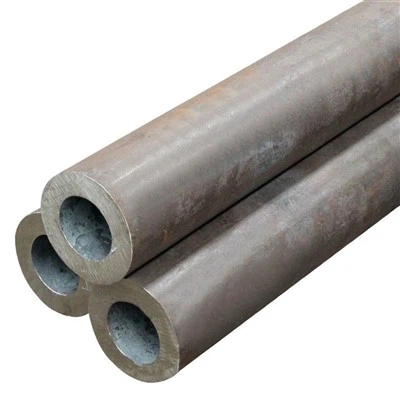
Hey there! As a supplier of Boiler Seamless Pipe, I often get asked about how to calculate the pressure drop in these pipes. It's a crucial aspect, especially for those who are using our pipes in various industrial applications. Today, I'm gonna break it down for you in a simple way.
First off, let's understand why pressure drop matters. In a boiler system, the seamless pipes are responsible for transporting fluids or gases. The pressure drop affects the efficiency of the entire system. If the pressure drop is too high, it can lead to increased energy consumption, reduced flow rates, and even potential damage to the equipment. So, getting an accurate calculation is super important.
There are several factors that influence the pressure drop in Boiler Seamless Pipe. The first one is the fluid properties. The density, viscosity, and flow rate of the fluid or gas passing through the pipe play a significant role. For example, a more viscous fluid will cause a higher pressure drop compared to a less viscous one.
The pipe characteristics also matter a great deal. The diameter of the pipe, its length, and the roughness of the inner surface all affect the pressure drop. A smaller diameter pipe will generally have a higher pressure drop than a larger one, assuming the same flow rate. And a rougher inner surface will cause more friction, leading to an increased pressure drop.
Now, let's talk about the methods to calculate the pressure drop. One of the most commonly used equations is the Darcy - Weisbach equation. It's given by:
$\Delta P = f \frac{L}{D} \frac{\rho v^{2}}{2}$
where $\Delta P$ is the pressure drop, $f$ is the Darcy friction factor, $L$ is the length of the pipe, $D$ is the diameter of the pipe, $\rho$ is the density of the fluid, and $v$ is the average velocity of the fluid.
The Darcy friction factor $f$ depends on the Reynolds number ($Re$) and the relative roughness of the pipe. The Reynolds number is calculated as:
$Re=\frac{\rho v D}{\mu}$
where $\mu$ is the dynamic viscosity of the fluid.
For laminar flow ($Re < 2000$), the Darcy friction factor can be calculated using the formula $f=\frac{64}{Re}$. For turbulent flow ($Re > 4000$), things get a bit more complicated. We usually use empirical correlations or Moody charts to determine the value of $f$.


Another method is the Hazen - Williams equation, which is often used for water flow in pipes. It's given by:
$\Delta P = 4.73 \frac{Q^{1.85}}{C^{1.85} D^{4.87}} L$
where $Q$ is the flow rate, $C$ is the Hazen - Williams coefficient (which depends on the pipe material and age), and the other variables are the same as before.
Let's take a practical example. Suppose we have a Carbon Round Boiler Pipe with a diameter of 0.1 m, a length of 10 m, and water flowing through it at a rate of 0.01 m³/s. The density of water is approximately 1000 kg/m³, and the dynamic viscosity is about $1\times10^{-3}$ Pa·s.
First, we calculate the average velocity of the water:
$v=\frac{Q}{A}=\frac{Q}{\frac{\pi D^{2}}{4}}=\frac{0.01}{\frac{\pi(0.1)^{2}}{4}}\approx1.27$ m/s
Then, we calculate the Reynolds number:
$Re=\frac{\rho v D}{\mu}=\frac{1000\times1.27\times0.1}{1\times10^{-3}} = 127000$
Since $Re > 4000$, it's a turbulent flow. We need to find the Darcy friction factor. Let's assume a relative roughness of 0.0001 for our pipe. Using a Moody chart or an appropriate correlation, we find that $f\approx0.02$.
Now, we can calculate the pressure drop using the Darcy - Weisbach equation:
$\Delta P = f \frac{L}{D} \frac{\rho v^{2}}{2}=0.02\times\frac{10}{0.1}\times\frac{1000\times(1.27)^{2}}{2}\approx1612.9$ Pa
It's important to note that these calculations are based on ideal conditions. In real - world applications, there may be additional factors such as fittings (elbows, tees, etc.), valves, and changes in elevation that can affect the pressure drop. Fittings and valves can cause local losses, which need to be accounted for separately.
For example, an elbow in the pipe can cause a significant pressure drop. The local loss coefficient ($K$) for an elbow depends on its type and the angle of the bend. The additional pressure drop due to a fitting is given by $\Delta P_{fitting}=K\frac{\rho v^{2}}{2}$.
When it comes to our Boiler Seamless Pipes, we offer a wide range of options to suit different needs. Whether you're looking for X60 OCTG Pipe for oil and gas applications or Oil Line Pipe for transporting oil, we've got you covered.
Our pipes are made from high - quality materials, which ensures a smooth inner surface and low friction, reducing the pressure drop. We also offer pipes with different diameters and wall thicknesses to meet your specific requirements.
If you're in the process of designing a boiler system or need to replace some pipes, accurate pressure drop calculations are essential. And if you're not sure how to do it or need some advice on which pipe to choose, don't hesitate to reach out. We have a team of experts who can help you with all your Boiler Seamless Pipe needs.
Whether you're a small - scale industrial user or a large - scale enterprise, we can provide you with the right pipes at competitive prices. So, if you're interested in our products or have any questions about pressure drop calculations or pipe selection, just contact us. We're here to make your boiler system work as efficiently as possible.
In conclusion, calculating the pressure drop in Boiler Seamless Pipe is a multi - step process that involves considering fluid properties, pipe characteristics, and using appropriate equations. With the right knowledge and the right pipes from us, you can ensure the optimal performance of your boiler system.
References
- Fox, R. W., McDonald, A. T., & Pritchard, P. J. (2012). Introduction to Fluid Mechanics. Wiley.
- Munson, B. R., Young, D. F., & Okiishi, T. H. (2012). Fundamentals of Fluid Mechanics. Wiley.