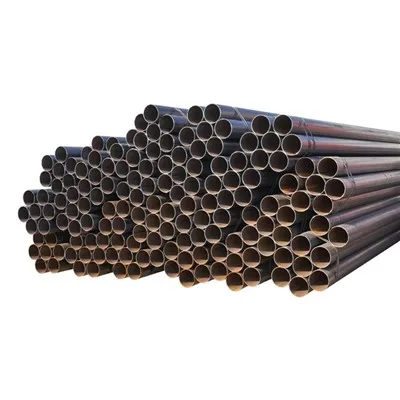
Modern pipeline networks, whether for oil, gas, water, or other industrial fluids, are rarely straight. They must navigate diverse terrains, avoid obstacles, and connect various facilities, necessitating frequent changes in direction. Traditionally, these directional changes were achieved through mitered bends (cutting and welding pipe sections at angles) or cold bending. However, for high-integrity, large-diameter pipelines, especially those constructed with Longitudinally Submerged Arc Welded (LSAW) steel pipes, these methods often fall short in terms of performance, efficiency, and long-term reliability. This is where induction bending emerges as the superior solution. But why is induction bending the superior solution for LSAW pipeline directional changes, and how does it enhance the integrity and operational efficiency of these critical systems? Hebei Huayang Steel Pipe Co., Ltd., a leading LSAW pipe manufacturer, explores the technical advantages of induction bending.
The Challenges of Pipeline Directional Changes
Changing the direction of a pipeline involves more than just altering its path. It introduces complex stresses and potential weaknesses if not executed correctly:
•Stress Concentration: Abrupt changes in direction can create stress concentration points, increasing the risk of fatigue failure or rupture.
•Flow Dynamics: Sharp bends can disrupt fluid flow, leading to turbulence, pressure drops, and increased erosion.
•Material Integrity: Traditional bending methods can sometimes compromise the pipe material's mechanical properties, especially in the weld seam area.
•Welding Requirements: Mitered bends require multiple field welds, increasing inspection needs, costs, and potential for defects.
•Space Constraints: Large-radius bends are often preferred but can be challenging to achieve with traditional methods in confined spaces.


What is Induction Bending?
Induction bending is a hot bending process that allows for the creation of smooth, large-radius bends in steel pipes while maintaining their mechanical properties. The process involves:
1.Clamping: The pipe is clamped at one end.
2.Heating: A narrow band around the pipe is heated to a precise temperature (typically 850-1100°C for steel) using an induction coil.
3.Bending Force: A bending arm applies a constant force to the free end of the pipe, pushing it through the induction coil.
4.Cooling: As the pipe exits the coil, it is immediately cooled (often with water spray) to control the microstructure and mechanical properties.
This localized heating and controlled bending allow the pipe to deform plastically into the desired radius without wrinkling, buckling, or significant thinning of the pipe wall.
Why Induction Bending is Superior for LSAW Pipes
Induction bending offers several compelling advantages, particularly when applied to LSAW steel pipes, making it the preferred method for critical pipeline directional changes:
1. Preserves Material Integrity and Mechanical Properties
•Controlled Heating: Unlike cold bending, which can induce significant residual stresses and strain hardening, induction bending's localized and controlled heating allows the steel to deform plastically at high temperatures. This minimizes residual stresses and prevents undesirable changes to the microstructure.
•Weld Seam Integrity: For LSAW pipes, the induction bending process is carefully controlled to ensure the longitudinal weld seam passes through the heated zone uniformly. The subsequent controlled cooling helps to normalize the weld and Heat Affected Zone (HAZ), restoring their mechanical properties to match the parent material. This is crucial for maintaining the pipe's overall strength and toughness.
2. Achieves Precise Geometry and Smooth Radii
•Customizable Radii: Induction bending can produce a wide range of bending radii, from tight to very large, allowing for optimal pipeline design that minimizes pressure drops and turbulence.
•Consistent Wall Thickness: The process is designed to minimize wall thinning on the outer radius and thickening on the inner radius, ensuring uniform strength throughout the bend.
•Excellent Roundness: The pipe maintains its roundness throughout the bend, facilitating smooth fluid flow and easy connection to straight pipe sections.
3. Reduces Welding and Inspection Requirements
•Single Piece Bend: An induction bend replaces multiple mitered welds, significantly reducing the number of field welds required. This translates to fewer potential points of failure, lower welding costs, and reduced NDT (Non-Destructive Testing) requirements.
•Enhanced Reliability: Fewer welds mean higher overall pipeline integrity and reduced risk of leaks or failures associated with field welding.
4. Cost and Time Efficiency
•Faster Installation: By providing pre-fabricated, high-quality bends, induction bending accelerates pipeline construction. Fewer field welds mean less time spent on site, lower labor costs, and reduced exposure to environmental elements.
•Optimized Design: The ability to create precise, large-radius bends allows engineers to optimize pipeline routes, potentially reducing overall pipeline length and material usage.
5. Suitable for High-Strength and Large-Diameter Pipes
LSAW pipes are often used for large-diameter, high-strength applications (e.g., API 5L X60, X70). Induction bending is particularly well-suited for these demanding materials and dimensions, where cold bending would be impractical or detrimental to material properties.
Hebei Huayang: Providing LSAW Pipes Optimized for Induction Bending
Hebei Huayang Steel Pipe Co., Ltd. manufactures high-quality LSAW steel pipes that are ideally suited for subsequent induction bending. Our pipes are produced with precise dimensional accuracy, excellent material homogeneity, and robust weld seam integrity, ensuring they perform optimally during the induction bending process.
We understand that the quality of the straight pipe directly impacts the quality of the final bend. By providing LSAW pipes that meet stringent international standards, we enable our clients to achieve superior directional changes in their pipelines, ensuring long-term operational safety and efficiency. Partner with Hebei Huayang for LSAW pipe solutions that integrate seamlessly with advanced bending technologies.
Advantages of Induction Bending for LSAW Pipeline Directional Changes
|
Advantage |
Description |
Benefit for Pipeline Projects |
|
Material Integrity |
Controlled heating prevents material degradation, preserves mechanical properties. |
Ensures strength, toughness, and ductility are maintained throughout the bend. |
|
Weld Seam Quality |
Heat treatment normalizes weld and HAZ, preventing brittleness. |
Maintains the full strength and reliability of the LSAW weld seam. |
|
Precise Geometry |
Achieves exact bending radii with minimal wall thinning/thickening. |
Optimizes fluid flow, reduces pressure drops, ensures smooth connections. |
|
Reduced Welding |
Replaces multiple mitered welds with a single, high-integrity bend. |
Lowers field welding costs, reduces inspection needs, enhances overall reliability. |
|
Stress Reduction |
Minimizes residual stresses compared to cold bending. |
Improves fatigue life and resistance to stress corrosion cracking. |
|
Versatility |
Suitable for large diameters, heavy walls, and high-strength steel grades. |
Adaptable to complex pipeline routes and demanding project specifications. |
In conclusion, induction bending is the superior solution for creating directional changes in LSAW pipelines, offering significant advantages over traditional methods. Its ability to preserve material integrity, achieve precise geometry, and reduce welding requirements directly translates to enhanced pipeline performance, safety, and cost-effectiveness. Hebei Huayang Steel Pipe Co., Ltd. provides the high-quality LSAW steel pipes that form the foundation for these advanced bending solutions, ensuring that your pipeline projects are built to the highest standards of engineering excellence. Contact us to discuss your LSAW pipe and bending requirements.