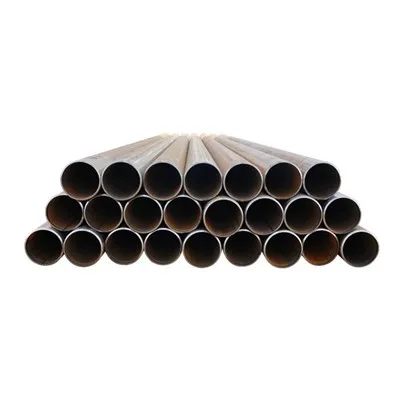
Understanding Carbon Steel
Definition and Composition Overview
Carbon steel is one of the most widely used materials in the industrial world. It is primarily composed of iron and carbon, with small amounts of other elements like manganese, silicon, and copper. The carbon content typically ranges from 0.05% to 2.0%, which significantly influences the material's hardness, strength, and ductility.
In the steel pipe manufacturing industry, carbon steel is valued for its strength-to-cost ratio, making it ideal for large-scale construction, oil and gas transport, mechanical systems, and structural applications. At Huayang Steel Pipe, carbon steel forms the foundation of our ERW and seamless steel pipe production lines.
How Carbon Steel Differs from Other Alloys
Unlike stainless steel, which contains high chromium and nickel to resist corrosion, carbon steel focuses on mechanical performance and weldability. This allows for better machinability, easier fabrication, and higher tensile strength at a lower cost.


Chemical Composition of Carbon Steel
Key Elements and Their Roles
The performance of carbon steel depends heavily on its chemical makeup. The following table summarizes the common elements found in carbon steel and their functional impact on the final product.
| Element | Typical Range (%) | Function in Steel |
|---|---|---|
| Carbon (C) | 0.05 – 2.0 | Determines hardness, strength, and brittleness |
| Manganese (Mn) | 0.30 – 1.65 | Improves strength, hardenability, and wear resistance |
| Silicon (Si) | 0.10 – 0.35 | Enhances strength and deoxidizes steel |
| Sulfur (S) | ≤ 0.05 | Improves machinability but can reduce ductility |
| Phosphorus (P) | ≤ 0.04 | Increases strength but lowers toughness |
| Copper (Cu) | ≤ 0.40 | Adds mild corrosion resistance |
Effect of Carbon Content on Properties
The percentage of carbon directly affects how the steel behaves. Low carbon content results in softer and more ductile steel, while high carbon levels make the steel stronger but less flexible.
Carbon Steel Classification by Carbon Content
| Type | Carbon Content (%) | Main Features | Typical Applications |
|---|---|---|---|
| Low Carbon Steel (Mild Steel) | < 0.30 | Ductile, easy to weld and form | Pipes, construction parts |
| Medium Carbon Steel | 0.30 – 0.60 | Balanced strength and ductility | Machinery, automotive parts |
| High Carbon Steel | 0.60 – 2.0 | Very strong, hard, less ductile | Springs, cutting tools |
Manufacturing and Processing of Carbon Steel Pipes
From Raw Material to Finished Pipe
At Huayang Steel Pipe, carbon steel production starts with high-grade hot-rolled coils or billets. The steel undergoes several forming and refining processes to achieve precise dimensions and stable mechanical performance.
Key Manufacturing Processes
- Forming: The steel strip or billet is shaped into a cylindrical form using advanced rolling mills.
- Welding (for ERW pipes): The edges are heated by high-frequency current and joined seamlessly.
- Heat Treatment: Normalizing or annealing ensures uniform grain structure and stress relief.
- Sizing and Straightening: Pipes are calibrated for accurate outer diameter and wall thickness.
- Testing: Every batch undergoes hydrostatic, ultrasonic, and visual inspections to meet international standards such as API 5L, ASTM A53, and EN 10219.
Mechanical Properties of Carbon Steel
Typical Performance Parameters
The mechanical behavior of carbon steel pipes makes them suitable for both structural and pressure applications. Below is a general overview of mechanical properties.
| Property | Low Carbon Steel | Medium Carbon Steel | High Carbon Steel |
|---|---|---|---|
| Tensile Strength (MPa) | 370–500 | 500–800 | 800–1200 |
| Yield Strength (MPa) | 250–400 | 400–650 | 650–900 |
| Elongation (%) | 25–35 | 15–25 | 10–15 |
| Hardness (HB) | 120–160 | 160–240 | 240–300 |
Impact of Heat Treatment
Heat treatment processes like normalizing, quenching, and tempering are often applied to modify these mechanical properties. For instance:
- Normalizing refines the grain structure and enhances toughness.
- Tempering reduces brittleness after quenching.
- Annealing restores ductility and workability for easier forming.
At Huayang, such processes are strictly monitored through automated thermal control systems to ensure consistency in every production batch.
Advantages of Carbon Steel in Industrial Use
1. Cost-Effective Strength
Carbon steel provides excellent mechanical performance at a fraction of the cost of alloyed materials. This makes it the go-to choice for pipeline systems, mechanical structures, and construction frameworks.
2. High Weldability and Formability
Especially for low and medium carbon steel grades, welding and bending operations are easily performed. This feature makes carbon steel pipes suitable for custom fabrication and on-site assembly.
3. Thermal and Pressure Resistance
When properly heat-treated, carbon steel can handle elevated temperatures and high pressures, making it essential for boiler tubes, refineries, and power plant pipelines.
4. Availability and Global Standardization
Standards such as ASTM A106, ASTM A53, and API 5L define clear specifications, ensuring global interchangeability and reliability across industries.
Huayang Steel Pipe: Your Trusted Carbon Steel Pipe Partner
Advanced Production Capabilities
Huayang operates over 40 high-frequency ERW production lines and several large-diameter SSAW and seamless lines, covering sizes from Φ73mm to Φ1422mm. All products adhere to ASTM, API, and EN standards.
Strict Quality Control
- Raw material chemical testing using optical emission spectrometers
- Online dimensional monitoring for wall thickness accuracy
- Hydrostatic and ultrasonic tests for integrity verification
- Third-party inspection by SGS, BV, and TUV agencies
Global Export and Support
Huayang carbon steel pipes are exported to more than 60 countries, serving sectors such as oil and gas, construction, shipbuilding, and power generation. Our technical team provides material selection, weight calculation, and specification consulting for international clients.
Conclusion
Carbon steel remains one of the most fundamental materials in modern engineering. Its balanced composition, mechanical strength, and economic advantages make it indispensable in countless applications.
At Huayang Steel Pipe, every carbon steel pipe represents a commitment to precision, durability, and global quality standards. Whether for high-pressure transport, structural frameworks, or energy projects, Huayang delivers carbon steel solutions that stand the test of time.