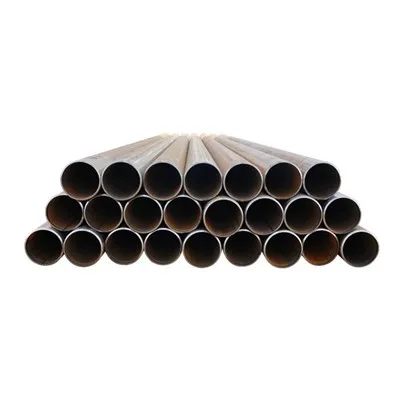
LSAW steel pipe and SSAW steel pipe both fall under the category of submerged arc welded pipes, but the key difference lies in the formation of the weld seam. LSAW steel pipe has a longitudinal weld seam aligned with the pipe axis: the steel plate is rolled into shape and welded along its length. SSAW steel pipe is produced by spirally forming a steel strip at a specific angle and welding along the helical seam, creating a continuous spiral weld.
Submerged arc welded pipes are widely used for long-distance energy transportation such as oil and gas pipelines, while seamless steel pipes are typically required for higher-performance environments such as oil and gas exploration.
LSAW steel pipe is manufactured by cutting, pre-bending, and forming steel plates before performing submerged arc welding (including single or double longitudinal welds). SSAW steel pipe is formed by continuously spiral-winding steel strip at an adjustable angle and then welding along the spiral direction.
Both SSAW and LSAW pipes are widely used in water transmission projects, structural engineering, and municipal construction. However, they differ significantly in several aspects.
Differences Between SSAW Steel Pipe and LSAW Steel Pipe
1. Differences in Pressure Capacity
SSAW Steel Pipe: Exhibits higher yield strength due to the helical distribution of the weld seam, allowing internal pressure to be dispersed along the spiral. Suitable for large-diameter, medium-to-low-pressure transportation scenarios. Offers flexible manufacturing advantages-can produce various diameters using the same strip width, even large diameters from narrow strips.
LSAW Steel Pipe: Weld seam is aligned with the pipe axis. Weld length is shorter and easier to control, making it suitable for high-pressure environments, long-distance oil and gas transportation, and high-load structural applications.
2. Specification Differences
| Pipe Type | Key Specification Features | Typical Application Scenarios |
|---|---|---|
| SSAW Steel Pipe | Commonly used in large diameters (ranging from several hundred millimeters to several meters) | Large-volume water transport, structural support |
| LSAW Steel Pipe | Broader size range (small to large diameters), with particular advantages in large-diameter and thick-walled pipes | High-pressure energy transmission, high-load structures |
3. Price Differences
SSAW Steel Pipe: Priced by the meter. High material utilization in the production process leads to lower overall production costs. Market price is generally several hundred RMB per ton lower than LSAW steel pipe.
LSAW Steel Pipe: Priced by weight. Higher costs due to more complex manufacturing processes, stricter inspection requirements, and advanced welding methods.
4. Differences in Manufacturing Process
LSAW Steel Pipe: Production process includes steel plate pre-bending, forming, and internal/external welding. Common forming methods: UOE and JCO. Characterized by straight longitudinal welds.
SSAW Steel Pipe: Produced using hot-rolled strip steel, which is spirally formed by adjusting the forming angle, then welded along the helical seam. Continuous welding process ensures high efficiency, suitable for large-scale production.
5. Differences in Weld Seam Form
LSAW Steel Pipe: Straight longitudinal weld seam, easier to inspect and evaluate for quality.
SSAW Steel Pipe: Helical weld seam covering the pipe surface. Longer weld seam makes thorough inspection more challenging.
6. Differences in Strength and Quality Control
LSAW Steel Pipe: Shorter, more controllable weld seam results in better weld stability and uniformity. Ideal for high-pressure, high-performance projects.
SSAW Steel Pipe: Longer weld seam increases the statistical likelihood of weld defects. However, modern production lines and optimized welding processes have significantly improved weld integrity, making it suitable for medium-to-low-pressure water transmission and foundation piling.
7. Differences in Application Fields
| Pipe Type | Core Application Areas |
|---|---|
| LSAW Steel Pipe | Long-distance high-pressure oil and gas pipelines, cross-regional energy networks, offshore platform structure supports, major construction projects |
| SSAW Steel Pipe | Urban water supply, sewage systems, structural foundation piling, bridge structures, municipal engineering |
8. Market Development Trends
LSAW Steel Pipe: Will maintain growth in high-end engineering markets (especially large-diameter and thick-walled pipes) with the development of energy infrastructure and large-scale construction.
SSAW Steel Pipe: Will continue to dominate medium-to-low-pressure fluid transportation and large-diameter projects due to cost-effectiveness. Technological improvements will further enhance its performance and reliability, enabling it to meet diverse market needs alongside LSAW pipes.


How to Choose Between LSAW Steel Pipe and SSAW Steel Pipe
The selection of pipe type requires careful consideration of project conditions, budget constraints, and construction requirements to ensure safety and cost-effectiveness.
1. Working Pressure Requirements
Prioritize LSAW steel pipe for high-pressure oil and gas transmission: Its shorter weld seam and higher weld quality offer better reliability under high pressure, high temperature, and harsh environments.
Choose SSAW steel pipe for medium-to-low-pressure scenarios (e.g., water transport, drainage, ventilation): Meets pressure requirements at a more competitive cost.
2. Budget Requirements
Opt for SSAW steel pipe if cost control is a priority: High material utilization and low production costs make it an economical solution for large-scale, high-diameter projects.
Select LSAW steel pipe for projects prioritizing safety and long-term stability (especially energy transportation): Superior performance justifies the higher cost.
3. Requirements for Pipe Length and Diameter
SSAW steel pipe: Supports flexible production of ultra-large diameters and continuous lengths, reducing the number of weld joints and improving installation efficiency.
LSAW steel pipe: Excels in scenarios requiring large diameters combined with thick walls, providing superior strength and stability.
4. Requirements for Dimensional Accuracy
LSAW steel pipe is preferred for projects requiring high construction accuracy: Offers superior roundness, straightness, and geometric precision, facilitating efficient installation and welding.
Conclusion
LSAW steel pipe and SSAW steel pipe each have distinct advantages and are not interchangeable-they serve different purposes based on project requirements.
LSAW steel pipe delivers higher strength, more controllable weld quality, and superior reliability, making it ideal for high-pressure, high-end applications (e.g., energy transmission, offshore engineering).
SSAW steel pipe offers flexible specifications and lower costs, making it more suitable for municipal construction, low-pressure fluid transmission, and foundation engineering.