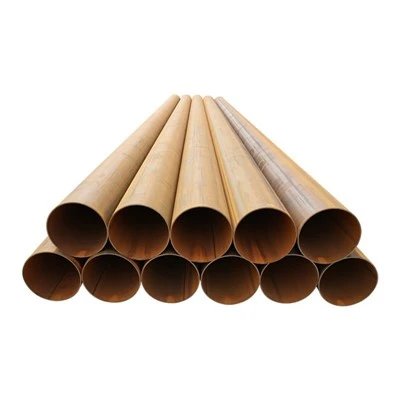
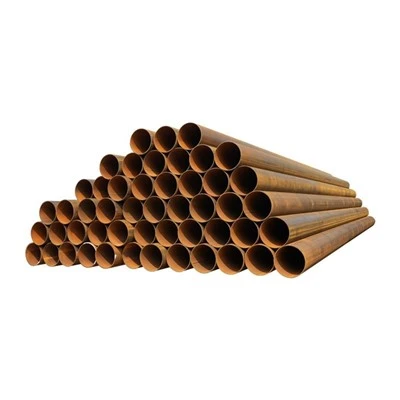
In oil and gas engineering, pipelines serve not only conduit for transporting media but also directly relate to engineering safety, stability, and long-term operational costs. Among various types of welded steel pipes, LSAW (Longitudinal Submerged Arc Welded) steel pipes and SSAW (Spiral Submerged Arc Welded) steel pipes are the two most commonly compared products in the oil and gas sector. There are obvious differences between them in manufacturing processes, structural characteristics, and engineering applicability.
This article provides a systematic comparison between LSAW and SSAW steel pipes based on the practical needs of oil and gas engineering, helping readers understand the boundary of application for each type of pipe in oil and gas projects.
I. Impact of Manufacturing Process Differences on Engineering Performance
LSAW steel pipes, fully known as longitudinal submerged arc welded steel pipes, use steel plates as raw materials, which are pre-bent, formed, and then longitudinally submerged arc welded. The welds are distributed along the pipe axis, with relatively short weld lengths and high controllability during the welding process.
SSAW steel pipes, namely spiral submerged arc welded steel pipes, are manufactured by continuously forming and welding steel strips at a certain helix angle. Their welds are spirally distributed, and the weld length is significantly longer than that of LSAW steel pipes.
In oil and gas engineering, welds are regarded as key parts requiring focus in pipeline systems. The longer the weld, the greater the theoretical workload for inspection and quality control. This is one of the important reasons why engineering projects tend to choose LSAW steel pipes with relatively simple weld structures under high-pressure and high-risk working conditions.
II. Comparison of Pressure Resistance and Safety Redundancy Comparison
Oil and gas pipelines generally operate under medium-to-high pressure, especially long-distance oil and gas transmission pipelines, which have clear requirements for the pressure resistance of steel pipes.
LSAW steel pipes are usually made of pipeline steel plates, with a wide range of wall thickness options. The stress direction of the longitudinal weld is consistent with the pipeline axis, so the stress distribution is more intuitive when bearing internal pressure, facilitating design and verification. This gives LSAW steel pipes a good safety margin in medium and high-pressure oil and gas pipelines.
Due to the spiral distribution of welds, the stress direction of SSAW steel pipe welds is relatively complex when bearing pressure, requiring correction through design calculations. Although it can also meet the service requirements under reasonable design and qualified manufacturing, design units often prefer LSAW steel pipes with clearer structural forms in high-pressure oil and gas engineering.
III. Dimensional Accuracy and On-Site Construction Adaptability
Oil and gas engineering has a long construction period and significant on-site welding work, which places high requirements on the dimensional consistency and end quality of steel pipes.
LSAW steel pipes are primarily formed from single steel plates, with relatively stable control of roundness, straightness, and wall thickness, and standardized pipe end processing, which is conducive to on-site alignment and circumferential welding operations. This is crucial in long-distance pipeline construction, as it can effectively reduce the rework rate and improve construction efficiency.
SSAW steel pipes adopt a continuous forming process, which has certain flexibility in large-diameter specifications, but higher requirements for manufacturing processes and equipment stability in terms of end consistency control. For oil and gas projects with complex construction conditions and strict welding requirements, LSAW steel pipes have more advantages in construction adaptability.


IV. Different Focuses on Inspection and Quality Control
The requirements for steel pipe quality in oil and gas engineering are reflected not only in the factory inspection stage but also throughout the entire project lifecycle.
LSAW steel pipes have short welds, and full weld non-destructive testing (including ultrasonic testing and radiographic testing) can usually be achieved. The testing path is clear, and defect identification is relatively straightforward.
SSAW steel pipes have long welds, resulting in a large inspection workload. Although they can also meet standard requirements through standardized testing, the quality control cost and management complexity are relatively higher at the engineering management level.
For this reason, LSAW steel pipes are more easily accepted by design institutes and owners in oil and gas main pipeline projects with extremely high safety requirements.
V. Typical Differences in Engineering Application Scenarios
From the perspective of practical engineering applications, the two types of steel pipes are not simply "superior or inferior" but have different applicable scenarios.
LSAW steel pipes are commonly used in:
- Oil and gas main transmission pipelines
- High-pressure pipelines
- Projects with high requirements for safety and service life
- SSAW steel pipes are commonly used in:
- Medium and low-pressure transmission pipelines
- Engineering with large diameter requirements and relatively low pressure grades
- Some municipal or auxiliary oil and gas supporting projects
During engineering selection, factors such as pressure levels, design lifespan, construction conditions, and project budget are usually comprehensively considered.
VI. The Importance of Proper Selection from an Engineering Perspective
In oil and gas engineering, steel pipe selection is not a simple cost comparison but a systematic engineering decision. Differences in initial material selection are often continuously amplified in construction difficulty, operational risks, and long-term maintenance costs.
With its stable structural form and good engineering adaptability, LSAW steel pipes have long occupied an important position in mid-to-high-end oil and gas projects; while SSAW steel pipes, relying on their specification flexibility and cost advantages, also play an irreplaceable role under specific engineering conditions.
Conclusion
Overall, LSAW and SSAW steel pipes have different focuses in oil and gas engineering. For oil and gas projects with high safety levels and large operational pressures, LSAW steel pipes are often a more reliable choice; while in engineering with relatively mild pressure conditions and obvious large-diameter requirements, SSAW steel pipes also have application value.
Huayang Steel Pipe has long been engaged in the welded steel pipe manufacturing field, focusing on the production and quality control of LSAW steel pipes. It has formed a mature system in raw material selection, welding processes, and inspection procedures, and can provide stable and reliable steel pipe solutions for oil and gas engineering projects.