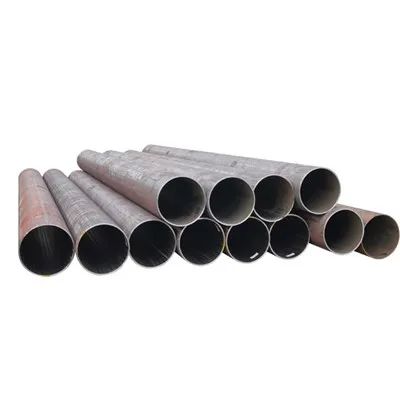
LSAW steel pipe processing methods mainly include two processes of LSAW steel pipe and LSAW high frequency steel pipe, LSAW steel pipe is a kind of welded steel pipe, which refers to the weld seam parallel to the longitudinal direction of the steel pipe, and its production process is relatively simple, the overall cost is low, and there are a variety of diameters and wall thicknesses that can be customized to pick, and it can be used for the production of large-calibre, thick-walled LSAW steel pipe, which will be described in detail below.
First, straight seam submerged arc welded steel pipe
1. Plate exploration: the production of large diameter LSAW steel pipe steel plate, the first full-plate ultrasonic inspection, no injury or damage to the next production process.
2. Edge milling: two edges of the steel plate through the milling machine for double-sided milling, to achieve the required width of the steel plate, the edge of the steel plate parallelism and the shape of the bevel.
3. Pre-bending: the edges of the steel plate are bent using pre-bending machine to get the required curvature of the steel plate.
4. Forming: the first half of the pre-bent steel plate is stamped several times and pressed into a 'J'shape on the JCO forming machine. Then, the other half of the plate is also bent and pressed to form a 'C'shape, and finally an open 'O'shape.
5. Pre-welding: The formed seam of the LSAW steel pipe is continuously welded by gas shielded welding (MAG).
6. internal welding: longitudinal multi-wire submerged arc welding (up to four wires) on the inside of the straight seam steel pipe welding.
7. external welding: using longitudinal multi-wire submerged arc welding on the outside of the straight seam submerged arc welded steel pipe.
8. the first ultrasonic inspection: the internal and external welds of the straight seam welded steel pipe and the parent material on both sides of the weld are inspected.
9. the first X-ray inspection: X-ray industrial television inspection of the internal and external weld seam, using an image processing system to ensure the sensitivity of the flaw detection.
10. Expansion: the whole length of the submerged arc welded straight seam steel pipe is expanded to improve the dimensional accuracy of the steel pipe, and improve the distribution of stress in the steel pipe.
11. Hydrostatic test: the expanded steel pipe is inspected one by one on the hydrostatic testing machine to ensure that the steel pipe reaches the test pressure required by the standard, and the machine has the function of automatic recording and storage.
12. chamfering: the qualified steel pipe end processing, to achieve the required pipe end bevelling dimensions.
13. the second ultrasonic inspection: again root by root ultrasonic inspection to check the LSAW steel pipe in the expansion, water pressure may produce defects.
14. the second X-ray inspection: X-ray industrial TV inspection and tube end weld filming of the steel pipe after the expansion and hydrostatic test.
15. Pipe end magnetic particle inspection: this inspection is carried out to find defects in the pipe end.
Second, straight seam high-frequency steel pipe
High-frequency welding process is based on the principle of electromagnetic induction, with AC charge in the conductor AC charge skin effect, proximity effect and eddy current heating effect, the edge of the welded steel is heated to a molten state after the roll extrusion process, you can make the intergranular bonding of the butt weld to achieve the purpose of welding.
High-frequency welding is a kind of induction welding, also called pressure-contact welding, which can be used without welding filler material, without welding spatter, with a narrow area affected by the welding heat in the welding, beautifully shaped after welding, and very good mechanical properties of welding.
Steel pipe high-frequency welding using AC power skin effect and proximity effect, the steel roll forming, forming the cross-section is divided into round billets. Rotate one or a group of impedance near the centre of the induction coil inside the billet, forming an electromagnetic induction circuit between the impedance and the opening of the billet. The skin effect and proximity effect produce a strongly concentrated thermal effect at the edge of the open section of the billet, which rapidly heats the weld edge to the temperature required for the weld.
High-frequency welding is a kind of induction welding, also called pressure contact welding, can be no welding filler material, no welding spatter, welding in the welding by the welding heat affected by the narrow area, welded after the welding of the beautiful moulding, welded mechanical properties are very good.
Steel pipe high-frequency welding using AC power skin effect and proximity effect, the steel roll forming, forming the cross-section is divided into round billets. Rotate one or a group of impedance near the centre of the induction coil inside the billet, forming an electromagnetic induction circuit between the impedance and the opening of the billet. The skin effect and the proximity effect produce a strongly concentrated thermal effect at the edges of the open part of the billet, which rapidly heats the welding edges to the temperature required for welding.