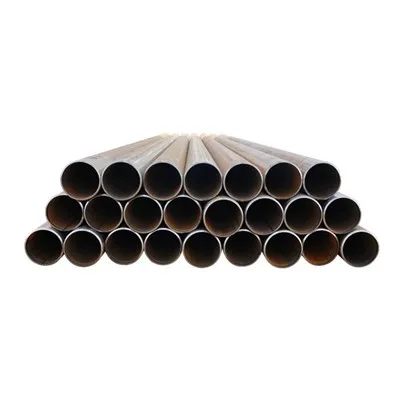
The Dual Components of Extrusion Pressure
In simple terms, the force exerted by the extrusion roll comprises two parts: one is the force required to press the open pipe until its two edges meet, and the other is the force needed to deform the heated edges during welding. LSAW Steel Pipe welding is a type of pressure welding. Once the two edges of the pipe are heated to the welding temperature, they must be pressed together under a specific external force. This force extrudes the oxides from the heated surface, forming the metal particles necessary for a strong weld. As such, the applied extrusion pressure is a critical process parameter in the production of LSAW Steel Pipe.
The Impact of Extrusion Pressure on Weld Quality
Essentially, a higher, yet appropriate, extrusion pressure is key to achieving a high-quality weld. When the extrusion pressure is insufficient, the oxides on the pipe edges are not adequately expelled, leading to non-metallic inclusions in the weld. These inclusions compromise the weld's continuity and can act as crack initiation points during stress tests. Additionally, lower extrusion pressure results in fewer standard crystals in the weld, yielding a loose and porous microstructure that is prone to cracking under load. Conversely, if the extrusion pressure is excessive, a significant portion of the high-temperature metal intended for crystallization at the pipe edge is forced out of the weld zone. This results in only a small amount of high-temperature metal crystals forming the weld, while cooler metal farther from the edge forms the weld crystals, leading to reduced bonding strength. It is crucial to note that the appropriateness of the extrusion pressure depends on maintaining a stable welding temperature. For LSAW Steel Pipe, excessive pressure is suitable for solid-state welding, but it is too high for fusion welding and too low for solid-phase welding.


Methods for Evaluating Extrusion Pressure
Several methods can be employed to assess the magnitude of extrusion pressure during LSAW Steel Pipe production:
Average Dimension Method: Measure the horizontal and vertical "diameters" of the pipe after it exits the extrusion roll, average them, and compare this value with the roll's orifice diameter. If the average is slightly larger, the extrusion pressure is considered normal; if it is smaller, a reduction in pressure is needed.
Reverse Observation Method: By inverting the pipe for about 50–80mm from the extrusion roll, one can observe any noticeable reduction in diameter ("necking"). Pronounced necking indicates excessive pressure, slight necking suggests proper pressure, and no necking points to insufficient pressure.
Dynamometer: This instrument is typically used as a reference to gauge the extrusion force.
Destructive Testing: Methods such as bending, flaring, or flattening tests are performed to evaluate weld strength, providing reliable, persuasive, and authoritative feedback on the extrusion pressure applied during the production of LSAW Steel Pipe.
Each of these methods has its limitations and application constraints. Therefore, if doubts arise about the extrusion pressure during production, multiple methods should be combined for a comprehensive evaluation. Additionally, even if both the extrusion pressure and welding temperature fall within the prescribed process range, an improper match with the welding speed may still result in a subpar weld.