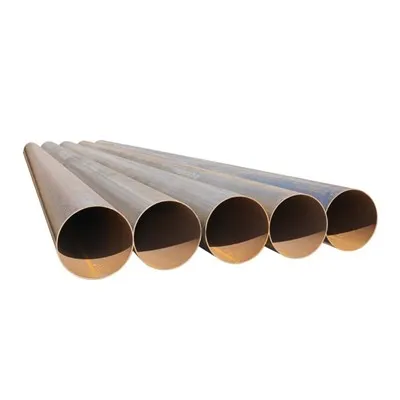
Electric Resistance Welded steel pipes are manufactured by forming hot rolled steel coils into a cylindrical shape and joining the edges through high frequency resistance welding. Because the weld seam is formed directly from the base metal, the chemical composition and mechanical properties of the steel grade used in production play a crucial role in determining the overall performance of the finished pipe. For this reason, carbon steel grades used for ERW pipe production must offer good weldability, stable mechanical strength, and reliable forming characteristics.
In global engineering projects, several carbon steel grades have become widely accepted for ERW pipe manufacturing. These grades are defined by different international standards and are selected based on the requirements of specific industries such as oil and gas transmission, municipal infrastructure, structural engineering, and industrial piping systems.
Overview of Common Carbon Steel Grades for ERW Pipes
Typical ERW Pipe Steel Grades in International Standards
| Steel Grade | Standard | Typical Yield Strength MPa | Common Application |
|---|---|---|---|
| ASTM A53 Grade B | ASTM A53 | 240 | Water, gas, and general industrial piping |
| API 5L Grade B | API 5L | 245 | Oil and gas transportation pipelines |
| API 5L X42 | API 5L | 290 | Medium pressure energy pipelines |
| API 5L X52 | API 5L | 360 | Long distance pipeline systems |
| API 5L X70 | API 5L | 485 | High pressure energy transmission |
Among international specifications, ASTM A53 Grade B is one of the most commonly used carbon steel grades for ERW pipes. It is widely applied in industrial piping systems that transport water, gas, and steam. The grade provides balanced mechanical properties with moderate yield strength and good ductility. These characteristics allow stable forming during the ERW production process while maintaining sufficient strength for general pressure applications.
API 5L Grade B is another widely used material for pipeline systems in the oil and gas industry. Compared with ASTM A53 Grade B, it is specifically designed for line pipe applications. The standard requires strict control over chemical composition and mechanical properties to ensure that pipelines can withstand internal pressure and environmental stresses during long term operation.
Higher strength grades such as X42, X52, and X70 belong to the API 5L pipeline steel family. The letter X indicates the minimum yield strength of the steel expressed in thousands of pounds per square inch. For example, X52 corresponds to a minimum yield strength of approximately 52 ksi. These grades are widely used in large scale pipeline projects because higher strength materials allow the use of thinner pipe walls while maintaining the required pressure resistance.
Carbon Steel Grades in Chinese ERW Pipe Production
Commonly Used Chinese Carbon Steel Materials
| Steel Grade | Standard | Typical Yield Strength MPa | Main Application |
|---|---|---|---|
| Q195 | GB standards | 195 | Light structural pipes |
| Q235B | GB standards | 235 | General construction and fluid transport |
| Q355B | GB standards | 355 | Structural engineering and heavy pipelines |
| L245 | GB pipeline standards | 245 | Oil and gas pipelines |
| L360 | GB pipeline standards | 360 | High strength pipeline systems |
In China, ERW pipe production commonly uses steel grades defined by the GB standard system. Among them, Q235B is one of the most widely applied carbon steel materials. The grade offers moderate strength, good plasticity, and stable weldability, which makes it suitable for a wide range of applications including construction structures, scaffolding systems, and fluid transportation pipelines.
Q355B provides higher strength compared with Q235B and is often used in engineering structures that require greater load bearing capacity. ERW pipes produced with Q355B are commonly used in large building frameworks, bridge structures, and heavy equipment support systems.
For pipeline transportation systems, Chinese standards also include grades such as L245 and L360, which correspond to pipeline steels similar to API 5L grades. These materials are designed for oil and gas transportation pipelines and must meet strict requirements for strength, toughness, and weldability.
The selection of these grades depends on the specific engineering conditions. For example, municipal infrastructure projects may prefer Q235B because of its cost efficiency and adequate mechanical performance, while energy transmission systems often require higher strength pipeline grades.


Influence of Steel Grade on ERW Pipe Manufacturing
The choice of carbon steel grade directly affects the production process of ERW pipes. During manufacturing, the steel strip must pass through a sequence of forming rolls that gradually shape the material into a cylindrical pipe. Steel grades with good ductility and uniform mechanical properties allow smoother deformation during this forming stage.
If the steel grade has excessively high carbon content or insufficient ductility, the strip may become more difficult to form. This can increase the risk of edge cracking or surface defects during the forming process. Therefore, carbon steel grades used for ERW production are typically designed with controlled carbon content to maintain good weldability and forming characteristics.
The welding stage is also influenced by the chemical composition of the steel grade. High frequency resistance welding relies on the rapid heating of the strip edges followed by mechanical pressure to create a solid phase bond. Steel grades with balanced carbon and manganese content allow stable heating and proper metallurgical bonding at the weld seam.
Higher strength grades such as X52 or X70 require more precise control of welding parameters. Because these steels have higher strength and different microstructure characteristics, manufacturers must carefully adjust welding temperature and squeeze pressure to achieve consistent weld seam quality.
Role of Steel Grades in Engineering Applications
Different engineering projects require pipes with different mechanical performance levels. As a result, selecting the appropriate carbon steel grade is an important step in pipeline design and procurement.
For general fluid transportation systems such as water supply pipelines or industrial piping networks, moderate strength grades like ASTM A53 Grade B or Q235B are usually sufficient. These materials provide adequate mechanical performance while maintaining cost efficiency.
Structural engineering applications may require higher strength materials such as Q355B or ASTM structural grades. In these cases, ERW pipes function as load bearing components in building frameworks or steel structures, so strength and dimensional stability are important considerations.
In oil and gas transportation systems, pipeline steels defined by API 5L standards are typically used. Grades such as X52 or X70 are selected based on pipeline pressure levels, transportation distance, and environmental conditions. Higher strength grades allow pipeline designers to optimize wall thickness while maintaining safety and performance.
Importance of Proper Material Selection in ERW Pipe Production
The success of ERW pipe manufacturing depends on the correct combination of raw material quality, production technology, and engineering design. Carbon steel grades used in pipe production must meet the requirements of international standards while also providing stable performance during forming and welding.
Modern pipe manufacturers carefully evaluate steel grades based on factors such as chemical composition, mechanical strength, weldability, and application environment. By selecting appropriate materials, manufacturers can ensure that ERW pipes achieve reliable weld seam strength, accurate dimensions, and long service life.
As global infrastructure projects continue to expand, the demand for high quality ERW carbon steel pipes remains strong. Understanding the characteristics and applications of common carbon steel grades helps engineers and manufacturers choose the most suitable materials for different pipeline systems and structural applications.